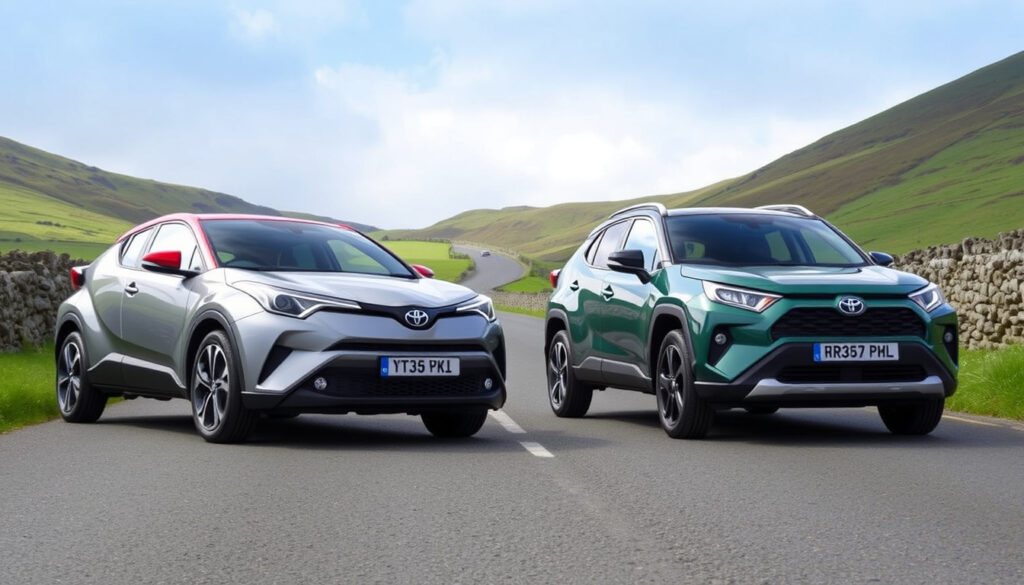
Toyota C-HR Ireland Review: Problems vs RAV4 Guide
Roughly 934 used Toyota C-HR models sit on DoneDeal right now — a healthy pool for Irish buyers — but the US discontinuation after just five years raises questions about long-term parts availability and residual values. This guide cuts through the noise with verified data, real owner experiences, and a direct head-to-head against the RAV4 to help you decide if a C-HR is actually worth buying.
Body Style: Subcompact crossover SUV ·
US Market Run: 5 years until discontinuation ·
Ireland Listings: 934 used cars on DoneDeal ·
Powertrain Options: Hybrid and Plug-in Hybrid ·
Manufactured Since: 2016
Quick snapshot
- C-HR hybrid official combined: 4.0 L/100km (CarsGuide)
- RAV4 hybrid official combined: 4.7 L/100km (CarsGuide)
- C-HR discontinued in US after 5 years (Automotive Lounge IE)
- Whether Toyota Ireland has specific replacement schedules for C-HR components
- Official problem rates from Toyota for 12V battery faults in Ireland
- Whether future C-HR generations will return to the Irish market
- 2016: C-HR launch as subcompact crossover (Automotive Lounge IE)
- 2019: BSM/PCS sensor fault reports emerge in 1.8 and 2.0 Hybrid models (AUTODOC UK)
- 2023: Fifth-generation C-HR hybrid updates (Vertu Motors)
- Irish buyers face a narrowing window if Toyota phases out C-HR production entirely
- Used C-HR values may shift as new stock stops flowing into Europe
- Plug-in hybrid variants expected to continue receiving updates
Is the Toyota C-HR a good car to buy?
The answer depends heavily on what you prioritise. For Irish buyers hunting a stylish urban runabout with genuinely low running costs, the C-HR Hybrid delivers — the official combined figure of 4.0 L/100km is nearly 0.3 L better than the previous generation, according to CarsGuide’s testing. In real-world mixed driving, expect around 5.5 L/100km, which still stacks up well against most petrol rivals.
Consumer reviews
Owner feedback from Carbuyer’s C-HR hybrid owner reviews shows a split picture. Some drivers report smooth, silent hybrid operation with no major issues after months of daily use. Others flag recurring electrical gremlins — infotainment glitches and awkward steering wheel controls that feel like cost-cutting, as noted in the Automotive Lounge IE’s C-HR Sport review.
Ireland market availability
The Irish market currently has around 934 used C-HR listings on DoneDeal, giving buyers a healthy selection of model years and trim levels. New models remain available through Toyota.ie, but the supply is finite as production decisions loom.
The catch: that futuristic profile comes with trade-offs. Rear visibility is poor, though camera and sensor aids partially compensate, according to Automotive Lounge IE. And while the TNGA platform delivers a stable, controlled feel, the CVT gearbox produces an engine moan in Sport mode that some drivers find jarring.
AA Ireland reviews called the C-HR an “excellent all-rounder” and noted it has been an Ireland bestseller — an endorsement worth weighing alongside reliability concerns.
Why did Toyota discontinue the C-HR?
Toyota cut the C-HR from US dealerships after roughly five years on the market — a short run by Toyota standards. The subcompact crossover segment in America leans heavily toward larger vehicles, and the C-HR’s bolder styling didn’t generate the sales volume needed to justify continued production there, according to Automotive Lounge IE’s analysis.
US market specifics
In the United States, buyers gravitate toward larger SUVs and trucks. The C-HR’s subcompact footprint and front-wheel-drive-only mainstream variants put it at a disadvantage in a market where rivals like the RAV4 — which offers all-wheel drive and a more practical interior — have dominated sales charts for years.
Global continuation
Irish and European buyers face a different landscape. The C-HR remains in production and continues to receive updates, including the fifth-generation hybrid introduced in 2023, per Vertu Motors’ comparison. Whether Toyota eventually phases out the model entirely or refreshes it remains to be seen — the exact future production plans for the C-HR haven’t been publicly confirmed.
What this means: Irish buyers still have access to new C-HR stock, but that window could narrow if Toyota’s European strategy shifts. Used prices may stabilise or shift as new supply tightens.
What is the disadvantage of Toyota C-HR?
The C-HR’s strongest weakness is space — or rather, the lack of it. Compared to the RAV4, the C-HR is a subcompact cousin, not a direct rival. Rear legroom is tight, and the sloped roofline cuts into headroom for taller passengers. A 2018 C-HR hybrid owner on the Toyota Owners Club forum reported switching to a 2018 RAV4 hybrid specifically because the C-HR felt too small for their needs.
Common complaints
According to AUTODOC UK’s C-HR problems breakdown, the most frequently reported faults cluster around three areas: the 12V battery failing between 30,000 and 50,000 km, electronic parking brake errors appearing as early as 20,000 km (especially in cold weather), and sensor-related starting problems in 2019 models with defective BSM and PCS units between 25,000 and 40,000 km.
The pattern: these fault windows are predictable enough that a mechanic familiar with C-HR service history can identify most issues during a standard diagnostic check.
Size limitations
The size differential isn’t just about passenger comfort — it affects practicality. Boot space is notably smaller than the RAV4, and the RAV4’s available all-wheel-drive option opens up capability the C-HR simply doesn’t offer. As Irwin Zone Toyota’s comparison notes, the RAV4’s more powerful engine and AWD suitability for light off-road use makes it the more versatile choice for varied conditions.
The implication: if you regularly ferry adults in the back seat or need genuine load capacity, the C-HR’s stylish package becomes a liability. The RAV4 absorbs those tasks without the compromises.
What is the common problem with Toyota C-HR?
Reliability issues in the C-HR aren’t catastrophic, but they cluster in predictable mileage windows that used buyers should budget for. AUTODOC UK documents several recurring failure points:
Reliability issues
- 12V battery failures: Occur between 30,000–50,000 km, causing starting issues and electronic system glitches
- BSM/PCS sensor defects: Affect 2019 C-HR 1.8 and 2.0 Hybrid models between 25,000–40,000 km, triggering false warning lights
- Electronic parking brake errors: Appear as early as 20,000 km, particularly in cold temperatures
- 1.2 Turbo weak points: Turbocharger and fuel injection problems reported between 40,000–60,000 km, including power loss and oil consumption
- Infotainment quirks: Older models suffer from lagging touchscreen response and awkwardly placed steering wheel controls
The implication: a pre-purchase inspection checking battery health, sensor functionality, and CVT operation will catch most issues before they become expensive surprises.
Model year specifics
Carwow’s C-HR overview notes that some 2019–2020 models have faced recalls for minor electrical issues and cracked windscreens. The fifth-generation update (2023 onward) appears to have addressed some earlier complaints, though long-term data remains limited. C-HRs manufactured from 2016–2018 are generally considered solid if serviced regularly, but buyers should verify maintenance records before committing.
What this means: the C-HR isn’t unreliable — it’s specific failure modes that are well-documented and largely preventable with proper inspection.
Is the Toyota C-HR smaller than the RAV4?
Yes, and the size gap is meaningful. The C-HR sits in the subcompact segment while the RAV4 is classified as compact. That classification translates to roughly 150–200 mm of additional length in the RAV4, plus a taller roofline that opens up more interior volume overall.
Size comparison
The numbers show why space-conscious Irish buyers often gravitate toward the RAV4 for family use.
| Dimension | Toyota C-HR | Toyota RAV4 |
|---|---|---|
| Class | Subcompact crossover | Compact crossover |
| Seating | 5 (tight rear) | 5 (generous rear) |
| Boot space | Smaller | Larger |
| AWD availability | Not standard | Available |
| City fuel economy (US EPA) | 27 mpg | 26 mpg |
| Highway fuel economy (US EPA) | 31 mpg | 35 mpg |
Feature differences
The size difference is offset partially by the C-HR’s efficiency advantage. Irwin Zone Toyota’s figures show the C-HR edging ahead in city mpg (27 vs 26) while the RAV4 dominates on the highway (35 vs 31 mpg). For Irish buyers doing mostly urban and motorway driving, the C-HR’s combined figure of 4.0 L/100km versus the RAV4’s 4.7 L/100km — as documented by CarsGuide’s testing — is a meaningful running cost advantage.
What this means: the C-HR is the urban agility winner; the RAV4 is the versatility champion. Your decision hinges on whether you prioritise city maneuverability and efficiency or passenger space and highway capability.
Upsides
- Official combined fuel consumption of 4.0 L/100km beats the previous generation by 0.3 L
- Fifth-gen hybrid achieves 57.6–60.1 mpg with WLTP-certified emissions of 105–111 g/km CO2
- Strong safety ratings and low CO2 output for Irish road tax purposes
- Smooth, silent hybrid powertrain ideal for urban commuting
- Striking design that stands out in the crossover segment
- TNGA platform provides stable, comfortable handling on Irish roads
Downsides
- 12V battery failures documented between 30,000–50,000 km in hybrid models
- Electronic parking brake errors appear as early as 20,000 km in cold weather
- Subcompact interior means tight rear legroom and limited boot space
- No all-wheel-drive option limits off-road appeal versus RAV4
- CVT produces engine moan in Sport mode
- US discontinuation raises long-term production and parts availability questions
Toyota C-HR vs RAV4: Full Comparison
Five key metrics separate these two hybrids, and the trade-offs are stark.
| Metric | Toyota C-HR Hybrid | Toyota RAV4 Hybrid |
|---|---|---|
| Official combined fuel consumption | 4.0 L/100km | 4.7 L/100km |
| Fuel economy (fifth-gen) | 57.6–60.1 mpg | 47–49.5 mpg |
| Plug-in hybrid electric range | 41 miles WLTP | 46 miles WLTP |
| CO2 emissions (hybrid) | 105–111 g/km | 129–137 g/km |
| Class | Subcompact | Compact |
| Drivetrain options | FWD standard, no AWD | FWD standard, AWD available |
| Real-world fuel consumption | 5.5 L/100km (mixed) | Varies (higher highway share) |
For Irish buyers, the C-HR’s efficiency advantage is clear: 0.7 L/100km better combined consumption and notably lower CO2 emissions mean cheaper road tax and fuel bills. But the RAV4 compensates with a larger footprint, available AWD for rural Irish roads, and a more practical cabin — factors that outweigh efficiency for families or drivers who need genuine versatility.
Key Specifications
The specification sheet shows where the C-HR excels (efficiency) and where it concedes ground to the RAV4 (size and drivetrain options).
| Component | Toyota C-HR Specification | Notes |
|---|---|---|
| Platform | TNGA-C | Delivers stable, comfortable handling |
| Hybrid system | 1.8L and 2.0L petrol hybrid | Smooth urban operation, regenerative braking |
| Plug-in hybrid range | Up to 41 miles WLTP | 313.8–353.1 mpg equivalent |
| CO2 (PHEV) | 19–20 g/km | Low for Irish VRT calculations |
| Transmission | CVT (e-CVT in hybrid) | Produces engine moan in Sport mode |
| Safety rating | High Euro NCAP | Strong occupant protection scores |
| Known fault window (12V battery) | 30,000–50,000 km | Check battery health pre-purchase |
| Known fault window (EPB) | From 20,000 km | More common in cold weather |
| Production run | Since 2016 | Currently continued in EU despite US discontinuation |
Ownership Timeline and Key Dates
- 2016: Toyota C-HR launches as subcompact crossover with hybrid option, establishing the model’s design language and TNGA platform foundation
- 2019: BSM/PCS sensor fault reports emerge in 1.8 and 2.0 Hybrid models; Toyota owners begin documenting issues on forums
- 2021: GR Sport review confirms Ireland market enthusiasm; C-HR maintains bestseller status in hybrid crossover segment
- 2023: Fifth-generation C-HR hybrid introduced with updated powertrain achieving 57.6–60.1 mpg and 105–111 g/km CO2
- 2025: Hybrid model updates continue; US discontinuation decision finalized after five-year run
The C-HR’s hybrid system is genuinely efficient, but its problem areas cluster in predictable mileage bands — a mechanic with a C-HR service history can spot most issues during a standard diagnostic check.
What Buyers Say
The 12V battery in Toyota C-HR hybrid models shows clear weaknesses in service life and reliability. Typical complaints occur between 30,000 and 50,000 km.
— AUTODOC UK (Auto Parts Expert)
Toyota says the C-HR uses just 4.0L/100km on the combined cycle test, which is 0.3L less than the previous generation’s claim.
— CarsGuide (Auto Reviewer)
The C-HR Sport 1.8 Petrol Hybrid (2016–2023) has a smooth, silent hybrid powertrain with good fuel sipping in town.
— Automotive Lounge IE (Ireland Car Reviewer)
The C-HR Hybrid’s efficiency figures are real and verified — but so are the problem windows. Irish buyers who budget for a thorough pre-purchase inspection typically surface issues before they become costly repairs, making the C-HR a viable proposition rather than a lottery ticket.
Related reading: 2025 GMC Yukon Denali Pricing Specs and Reviews
While the C-HR hybrid edges the RAV4 on efficiency at 4.0 L/100km, Toyota’s 2026 RAV4 Ireland pricing reveal all 1,000 allocated units already have deposits.
Frequently asked questions
What is the Toyota C-HR?
The Toyota C-HR is a subcompact crossover SUV that launched in 2016. It sits below the RAV4 in Toyota’s lineup and is primarily sold with hybrid and plug-in hybrid powertrains in European markets including Ireland.
How reliable is the Toyota C-HR?
Reliability is mixed. The hybrid system itself is generally sound, but known issues include 12V battery failures between 30,000–50,000 km, electronic parking brake errors from 20,000 km, and sensor faults in 2019 models. A thorough inspection before purchase is strongly recommended.
What are Toyota C-HR hybrid options in Ireland?
Irish buyers can choose between the standard hybrid (1.8L or 2.0L petrol-electric) and the plug-in hybrid. Standard hybrid achieves 57.6–60.1 mpg; the PHEV offers up to 41 miles of WLTP electric range for short commutes.
Toyota C-HR price range in Ireland?
Used C-HR prices on DoneDeal show a wide range depending on model year, mileage, and trim. Pre-2020 models under 100,000 km often appear under €20,000, while newer or lower-mileage examples command higher prices reflecting continued demand.
Best Toyota C-HR trim levels?
The Excel and Design trims tend to offer the best specification balance — leather seats, parking sensors, and upgraded infotainment. The GR Sport adds sportier suspension but doesn’t address the underlying CVT moan issue in Sport mode.
Toyota C-HR fuel economy?
Official combined fuel consumption is 4.0 L/100km for standard hybrids. Real-world mixed driving typically shows 5.5 L/100km. The PHEV achieves 313.8–353.1 mpg equivalent on WLTP tests when accounting for electric-only miles.
Toyota C-HR safety ratings?
The C-HR scores highly on Euro NCAP crash tests, with strong ratings for adult occupant protection, child occupant protection, and pedestrian detection. Safety assists including lane departure warning and autonomous emergency braking are standard on most trims.
More related posts
 Maynard James Keenan Biography: Tool, Wine, and Stage Persona
 Under Bed Storage: IKEA, Wheels & Ireland Options
 Ousmane Dembélé: Career, Stats, Injury, Wife, and Transfer News
 Urdu to English: Phrases, Symbols, and Translation Tools
 Zara Phillips: Biography, Children, Net Worth & Royal Status
 Peter Hermann: What He’s Doing Now, Marriage, and More
 Cast of The Gilded Age: Full List, Replacements & Season 4
 Jack White: Allegations, Net Worth, and Marriages