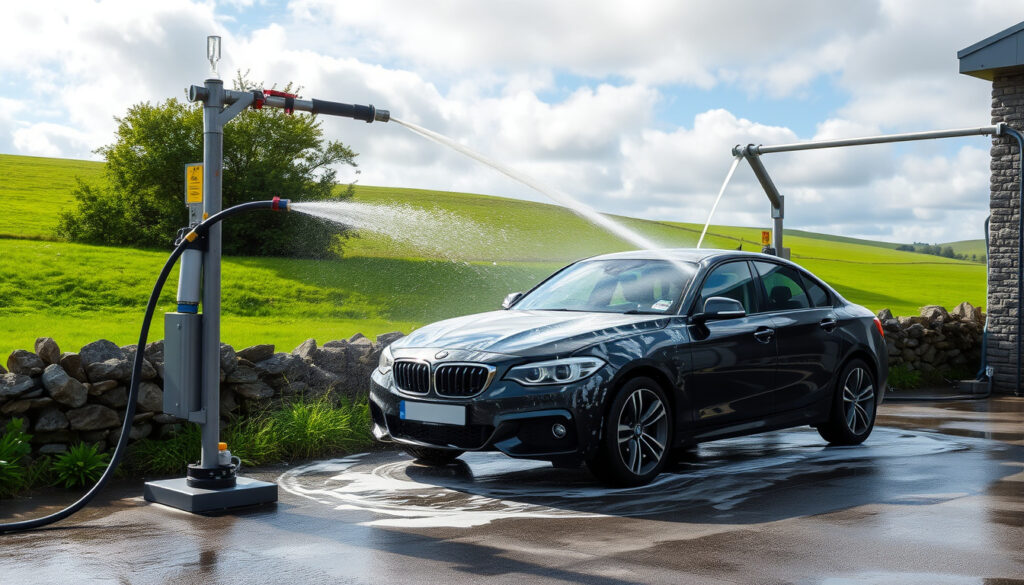
Self Car Wash Near Me in Ireland: Prices & Locations
For Irish car owners on a budget, Applegreen’s self-service units at €1 per 3 minutes are the best-value option in the country — but knowing which chain operates where, what extras cost, and whether you can blast your car on your own driveway still takes some sorting out.
Starting price: €6 for 6 minutes (Certa self-service) · Major chains: Applegreen, Circle K, Maxol · Basic wash range: €8–€20 across Ireland
Quick snapshot
- Applegreen self-service units run at €1 for 3 minutes or €2 for 7 minutes (Applegreen)
- Full valet packages in Ireland average €140 (Crystal Valet)
- Circle K offers brushless car wash programs alongside standard options (Circle K Ireland)
- Exact breakdown of Maxol’s self-serve versus fully automated-only locations
- Whether Certa’s self-service bays accept contactless card payment at every site
- More operators are trialling brushless and water-recycling systems as eco-conscious buyers demand lower-impact options (Crystal Valet)
- Self-service bays at fuel stations increasingly accept Apple Pay and Google Pay alongside coins (Crystal Valet)
- Tight budget → Applegreen self-service at €1/3 min
- Least paint damage → Circle K brushless program
- Full-service speed → Applegreen premium wash at €15
| Factor | Details |
|---|---|
| Cheapest self-wash | €1 for 3 minutes at Applegreen |
| Premium automatic wash | €15 at Applegreen (includes rainfall foam, under-chassis wash, VIP drying) |
| Market basic wash range | €8–€20 across Ireland (automatic and hand wash combined) |
| Full valet package | Approximately €140 |
| Applegreen locations | 30+ nationwide |
| Circle K specialty | Brushless washing programs |
| Maxol specialty | Automatic eco-friendly washes |
| Crystal Valet coverage | Dublin, Limerick, Cork, Galway |
What are self-cleaning car washes called?
In Ireland and the UK, the term “self-cleaning car wash” typically means a self-service bay — a coin-operated or card-operated station where you hold the lance yourself. These are distinct from fully automated tunnel washes where the car moves through on a conveyor.
You’ll also hear the terms “jet wash,” “coin-op wash,” and “self-serve bay” used interchangeably. Fuel retailers like Applegreen, Circle K, and Maxol all operate some form of self-service unit alongside their automatic washes. At Applegreen specifically, the self-service pods let you pay €1 for 3 minutes of high-pressure water — useful for a quick pre-wash or a targeted bug-blast on the front end.
The distinction matters because self-serve bays give you control over pressure and soap, but they require your own effort. If you want the car done fast with zero effort on your part, an automatic wash is the move — but it’ll cost more and may involve brushes that could introduce micro-scratches over time.
Some operators market their automated bays as “touchless” or “brushless,” which means high-pressure water and detergent only, no physical bristle contact. Circle K explicitly flags brushless programs as an option, making them worth a look if you’re worried about paint integrity.
Self-service vs self-cleaning
The two terms overlap but aren’t perfectly synonymous. “Self-service” describes the user model — you do the work. “Self-cleaning” is more of a marketing phrase that can apply to automated systems that need minimal human input. When searching for a self car wash near you in Ireland, stick with “self-service” or “jet wash” as your search terms for the most relevant results.
Common names in Ireland
- Jet wash (most common term on signage)
- Self-serve bay
- Coin-operated wash
- Self-service car wash
- Automatic car wash (when referring to tunnel systems)
What are 3 types of car washes and how to choose the right one?
The car wash market in Ireland broadly breaks into three models, each with a distinct trade-off between cost, effort, and paint safety.
Self-serve bays put the work in your hands. You pay per minute, control the pressure, and can target specific areas. This is the cheapest route per wash — Applegreen’s units charge €1 for 3 minutes — but it takes 15–30 minutes of your time and the results depend entirely on your technique.
Automatic brush washes move your car through a tunnel on a conveyor. Brushes rotate against the paintwork. They’re fast — you’re done in 3–5 minutes — and relatively affordable, with basic packages starting around €8 at many Irish service stations. Applegreen’s basic tier at €10 adds rainfall foam pre-soak, alloy rim prep, ultra-soft brush wash, high-pressure wheel wash, premium wax, and drying; the mid-tier at €13 adds a full contouring high-pressure wash and under-chassis rinse. The catch is that worn brushes can introduce micro-scratches over time, which won’t be visible today but accumulate in the clear coat.
Touchless or brushless washes use high-pressure water and detergents only — no physical contact. They’re gentler on paint and work well for regular maintenance washes. They’re typically priced similarly to brush washes but may require two passes for heavy soiling since there’s no mechanical agitation.
For most Irish car owners, a quarterly automatic or touchless wash plus monthly self-serve touch-ups hits a good balance between cost, paint care, and effort, according to industry guidance from Crystal Valet.
The takeaway: self-serve rewards effort with the best cost and paint safety; automatic washes trade money for speed; touchless washes hit the middle ground on both.
Touchless
If you drive a leased vehicle or care deeply about maintaining resale value, touchless is the lowest-risk option among automated washes. The trade-off is that stubborn bonded contaminants — dried bird lime, tar spots — may need a follow-up hand wash or tar remover to fully shift.
Self-Serve vs. Automated Express Car Wash: Which One Is Right for You?
Choosing between a self-serve bay and an automated express wash isn’t just about price — it’s about what you’re trying to achieve and how much time you have.
Self-serve works best when you need targeted cleaning — the front grille after a motorway run, the wheel arches after a rural road, or the undercarriage in winter when road salt is at its most corrosive. You’re in the bay for 10–20 minutes, but you can hit exactly the spots that need attention. Budget-wise, Applegreen’s €1-per-3-min units make this the most economical option available in Ireland.
Automated express washes make sense when speed is the priority — you’re dropping the car off and collecting it minutes later with no effort on your part. Applegreen’s premium €15 package includes rainfall foam pre-soak, ultra-soft brush wash, premium wax, under-chassis wash, rain shield surface protect, VIP drying, premium foam polish, and brush polish buffing — a level of finish that’s difficult to replicate DIY.
The trade-off is obvious: automated washes cost more and surrender your control over the process. You can’t target specific areas, and if the brushes are worn or the equipment miscalibrated, you get the same wash as everyone else — which might not suit your car’s needs.
Self-serve is cheaper and more targeted, but it’s only as good as your technique. Rushing through a self-wash with a worn sponge or incorrect pressure defeats the purpose — spend the extra 5 minutes and you’ll notice the difference.
When to choose each
- Choose self-serve: budget washes, winter salt removal, post-rural-road clean, targeted bug removal, undercarriage treatment
- Choose automated: time-poor situations, pre-event quick polish, regular weekly maintenance if you’re not DIY-inclined
- Choose touchless: leased vehicles, cars with softened paint or protective films, regular maintenance between deeper cleans
For most Irish car owners dealing with winter road salt, self-serve undercarriage washes are worth the effort — the salt buildup that forms in wheel arches and chassis rails causes corrosion that a surface-level automated wash simply won’t touch.
How to use Tesco Jetwash?
Tesco operated jet wash facilities at some of its Irish fuel station sites, though the availability of specific Tesco Jetwash units has varied over time as the retailer restructured its forecourt operations. For current availability, checking the Tesco Fuel Finder on their website or calling the specific site before visiting is the most reliable step.
The general process for using any jet wash or self-serve bay in Ireland follows a roughly similar pattern, regardless of brand.
Steps for jet wash
- Drive into the bay and position your car — most bays have marked guide lines
- Select your program on the panel or insert coins/card to activate the system
- Start with a pre-rinse cycle to loosen surface dirt (2–3 minutes is usually enough)
- Apply foam or shampoo if the bay offers it — some Applegreen units have this as an add-on
- Use the high-pressure lance to target lower panels, wheel arches, and undercarriage
- Rinse thoroughly, working top-to-bottom to avoid re-depositing dirt
- For winter months: dedicate at least 2 minutes to undercarriage spray — road salt in Ireland is particularly corrosive
A typical jet wash session for a moderate dirt level runs 8–12 minutes. Budget around €3–€4 for that duration at most Irish operators.
Don’t hold the lance too close to painted surfaces — high-pressure water at very close range can drive water past seals and into door cavities, boot rubbers, and windscreen channels. Keep the nozzle at least 15–20 cm from the surface and use a wide fan spray for rinse-down phases.
Duration and cost
At Applegreen’s self-service units, you can buy time in increments: €1 buys 3 minutes, €2 buys 7 minutes. That’s notably more generous than many UK jet wash setups. For a full exterior wash including pre-soak, main wash, and rinse, budget 10–12 minutes total. If you’re also doing interior mat cleaning via the steam mat cleaner add-on (also €1 per 5 minutes at Applegreen), add another 5–8 minutes.
Can I wash my car on driveway in Ireland?
This is where Irish regulations come into play — and the answer isn’t a flat yes or no. The key issue is water runoff. If you’re using a hose or pressure washer on your driveway and that water flows into the public drain or road gully, you’re potentially creating a pollution issue. Domestic pressure washer runoff can carry soap, oil, and brake dust into the local water system.
Irish water regulations and local authority bylaws restrict the discharge of trade effluent (which can include soapy water from vehicle washing) into public drains. For homeowners washing their own car on their own driveway, the practical risk is generally low — but if you’re washing a work vehicle or multiple vehicles regularly, this moves into a different regulatory category.
Regulations
Under Irish water pollution law, discharging harmful substances to water is prohibited. The grey area is whether a domestic car wash constitutes a “harmful substance” — plain water with mild shampoo is unlikely to trigger enforcement, but if the runoff is visibly oily or the local authority has specific bylaws, you could be in trouble. Professional car wash operators must hold appropriate waste discharge licences. The practical takeaway is that if your driveway drains to a public gully, keep the wash short, use minimal soap, and point the discharge toward your lawn or garden if possible.
The simplest workaround: use a self-serve bay. The wash water at professional sites is directed to oil-water separators and proper drainage systems, keeping you fully compliant.
Alternatives
- Self-serve car wash bay: compliant, professional equipment, controlled water and soap use
- Bucket and sponge on lawn: runoff soaks into grass rather than entering drains — slower but low-cost
- Waterless wash products: spray-on formulas that require no hose or rinse — increasingly available in Irish automotive shops
- Mobile detailing services: some operators bring their equipment to your location; they handle waste disposal
Self-Serve vs. Automated Car Wash Comparison
Three parameters, three clear trade-off patterns: cost versus effort versus paint risk.
| Factor | Self-Serve Bay | Automatic Wash |
|---|---|---|
| Typical cost per session | €1–€5 (Applegreen: €1/3 min) | €8–€15 (Applegreen basic to premium) |
| Time required | 10–20 minutes active work | 3–5 minutes (drop and go) |
| Paint risk | Zero if you use correct technique | Micro-scratches from worn brushes possible |
The implication: self-serve is the clear winner on cost and paint safety, but demands your time and attention. Automated washes win on convenience — and Apple’s premium €15 package delivers a finish that most DIYers can’t match without significant equipment investment.
Car Wash Operators in Ireland — Spec Table
Six operators, six different value propositions — and pricing that spans from €1 per 3 minutes to €15 for a premium tunnel wash.
| Operator | Self-Serve | Automatic Options | Special Features | Locations |
|---|---|---|---|---|
| Applegreen | €1/3 min, €2/7 min | €10 basic, €13 mid, €15 premium | Steam mat cleaner €1/5 min, 30+ sites nationwide | Ashbourne, Balbriggan, Baldoyle, Ballincollig, Booterstown, Celbridge, Clonmel, Clonsilla, Cork (Cobh), Ennis, Galway Tuam Road, Gorey, Listowel, Millenium Park, Monkstown, Navan Retail Park, Portlaoise, Santry, Swords, Trim, Tullamore + more |
| Circle K | Not confirmed available | Regular + brushless programs | Brushless option for paint-safe washing | Multiple fuel station sites across Ireland |
| Maxol | Exact self-serve availability unclear | Automatic eco-friendly washes | Rainwater recycling and eco-friendly wash chemicals | Multiple sites across Ireland |
| Crystal Valet | Not applicable (full-service) | Not applicable | Hand wash, full valet (€140), premium detailing (€150+) | Dublin, Limerick, Cork, Galway |
| Certa | Self-serve from €6/6 min | Not confirmed | 11 self-serve jet wash sites | Various sites |
| Tesco | Historically available at some sites | Availability varies by site | Check site-specific before visiting | Selected Tesco fuel stations |
Upsides
- Self-serve costs as little as €1 per 3 minutes at Applegreen — cheaper than any automatic wash
- DIY control lets you target winter salt buildup in wheel arches and undercarriage
- Brushless programs at Circle K offer the gentlest automatic option for paint protection
- Self-serve water at professional bays goes through oil-water separators, keeping you compliant
- Applegreen’s 30+ sites make it the widest-coverage self-serve network in Ireland
Downsides
- Self-serve takes 10–20 minutes of active effort per session
- Maxol’s exact self-serve availability remains unclear from current sources
- Automatic brush washes risk micro-scratch accumulation from worn equipment
- Touchless washes may need two passes for heavy soiling
- Full valet at €140+ is 14–35× the cost of a single self-serve session
How to Use a Self-Serve Car Wash Bay — Step by Step
If you’ve never used a self-serve bay, the process is straightforward — but doing it properly makes a meaningful difference to the results. Here’s the sequence that experienced users follow.
A rushed 5-minute self-wash removes surface dirt but misses the salt, brake dust, and road film that cause long-term corrosion. The extra 10 minutes spent on undercarriage and wheel arches in winter pays dividends in bodywork longevity — particularly in Ireland where road salt application is heavy and prolonged.
Step 1 — Arrive prepared
Bring a dedicated car wash mitt or soft sponge (not a kitchen sponge), a bucket if you want to pre-soak panels, and a chamois or microfibre drying towel. Some bays provide equipment on-site but don’t rely on it being in good condition.
Step 2 — Pre-rinse cycle
Activate the bay and spend the first 2–3 minutes on a pure water rinse with no soap. This removes the bulk layer of loose dirt and reduces the risk of dragging particles across the paint during the main wash. High-pressure lances work well here — work from the roof down, directing water at wheel arches, sills, and the undercarriage.
Step 3 — Foam and main wash
If the bay offers a foam option, activate it now and let it dwell for 60–90 seconds before rinsing. Some Applegreen units have this built in. Work panel by panel, using the high-pressure lance in a wide fan pattern. For stubborn areas (front grille, lower doors, rear bumper), use the pinpoint nozzle but keep it at a safe distance from painted surfaces.
Step 4 — Winter special: undercarriage blast
Ireland’s road salt treatments are harsh, and the undercarriage, wheel arches, and brake calipers cop the worst of it. Allocate at least 2–3 minutes to a dedicated undercarriage rinse in the winter months. Many self-serve bays have a dedicated under-chassis jet — use it. This is where the self-serve model genuinely outperforms a quick automated tunnel wash.
Step 5 — Final rinse and dry
Run a clean water rinse to flush any remaining soap or salt solution. Then dry with a chamois or quality microfibre towel, working in straight lines rather than circular motions to avoid swirl marks. If you don’t have a drying cloth, let the car air-dry in a shaded spot — avoid direct sunlight on a freshly washed car as water spots will bake onto the paint.
Crystal Valet recommends a quarterly full valet with monthly quick washes in winter for most Irish car owners — the self-serve bay is the ideal tool for those frequent maintenance washes without the cost of professional attention.
What’s Confirmed and What Needs More Data
The Irish self-serve car wash market is fairly transparent at the operator level — Applegreen publishes its pricing, location list, and service menu directly on its website. The gaps are in regional coverage mapping (which towns have which operators), real-time availability (is this bay currently working?), and user-submitted quality ratings that would allow meaningful chain-to-chain comparison.
Confirmed facts
- Applegreen operates 30+ car wash locations nationwide with self-service units at €1 per 3 minutes
- Applegreen’s premium automated wash package costs €15 and includes under-chassis wash, VIP drying, and brush polish buffing
- Basic automatic or hand wash services across Ireland range from €8 to €20
- Full valet packages in Ireland average around €140
- Circle K offers brushless car wash programs as a paint-safe alternative to brush washes
- Crystal Valet operates in Dublin, Limerick, Cork, and Galway
What needs more data
- Maxol’s precise self-serve availability versus fully automated-only sites
- Certa’s exact payment method acceptance (coin-only versus card/cashless)
- Current Tesco Jetwash availability at specific Irish sites — this has been inconsistent
- User ratings and reviews by location for individual operators — helpful for quality verification
What this means: if you’re in Dublin, Cork, or Galway and looking for a self car wash near you, Applegreen is your most reliable starting point — you can check their website for specific site-level details. For rural locations, Certa’s 11 self-serve sites may be your nearest option. Circle K’s brushless program is worth seeking out if you’re prioritising paint care over cost.
In Ireland, where weather and road treatments can be harsh on vehicles, a mix of regular quick washes and occasional deep valets or detailing is a practical plan.
— Crystal Valet (Crystal Valet car care guide)
Discover the exciting future of self-service car care at Applegreen today.
— Applegreen (Applegreen car wash page)
For Irish car owners dealing with motorway commutes, rural roads, and the country’s heavy road salt application each winter, the equation is fairly clear: a self-serve bay gives you the most wash for the least money, and the extra effort pays off in targeted undercarriage cleaning that automated tunnel washes simply don’t provide. The right choice depends on whether you’re counting centimetres on time or centimetres on paint condition.
If you’re on a lease or planning to sell, Circle K’s brushless program or Applegreen’s premium €15 package is money well spent on paint preservation. If you’re running an older car and need functional cleanliness on a budget, Applegreen’s self-service units at €1 per 3 minutes are the standout value play in the Irish market right now — with 30+ sites nationwide, the odds are good there’s one near you.
Related reading: Cairns Airport Parking Guide · Transfer Rego NSW Guide
Frequently asked questions
What is the best self car wash near me?
Applegreen offers the most widely available self-serve network in Ireland with 30+ sites and pricing starting at €1 for 3 minutes. For the highest-quality automatic wash, their €15 premium package includes under-chassis wash, VIP drying, and brush polish buffing. Check Applegreen’s site finder for your nearest location and current bay availability.
What are Maxol car wash prices?
Maxol focuses on automatic eco-friendly washes rather than self-serve. Their specific pricing isn’t published centrally — check the Maxol website or your local Maxol station directly for current rates. Their eco-friendly angle (rainwater recycling, green wash chemicals) is their primary differentiator rather than being the cheapest option.
Are there mobile self car washes?
Yes, some mobile detailing operators operate in Irish cities and will bring equipment to your location. These typically offer hand wash and interior cleaning services. They cost more than self-serve bays but are more convenient and handle wastewater responsibly. Search for mobile car valet + your city for local operators.
What makes touch-free car washes least damaging?
Touchless or brushless washes use only high-pressure water and detergent — no physical bristle contact. This eliminates the risk of micro-scratches caused by worn or dirty brushes in automatic tunnel washes. Circle K explicitly offers brushless programs for this reason. The trade-off is that heavily soiled cars may need two passes to shift bonded contaminants.
Is coin-operated self wash dying out?
Not in Ireland — Applegreen has expanded its self-service network to 30+ sites, and Circle K continues to operate car wash facilities at fuel stations. The technology has evolved to accept contactless card and mobile payments alongside coins, making self-serve more convenient than ever. What has changed is the quality bar: operators investing in brushless programs and eco-friendly wash chemistry are raising the overall standard.
Can I wash my car on my driveway in Ireland?
Technically possible but with caveats. Water runoff from a domestic driveway wash can flow into public drains, creating a potential pollution issue if soap or oil is present. The safest approach is directing runoff to your lawn or garden, using minimal soap, or simply using a self-serve bay where the operator handles wastewater compliance. For a work vehicle or regular commercial washing, you’d need appropriate trade effluent permissions.
More related posts
 Chloe Stroll: Biography, Net Worth, and Scotty James
 Wooden Chopping Boards: Wood Types, Hygiene & Care
 Summer McIntosh: Latest News, Records & Comparisons
 Nasiah Wanganeen-Milera: Career, Family, Injury & Stats
 Gen Alpha: Age Range, Traits, and Gen Z Comparison
 Jamie Dornan: Biography, Netflix Series, and Family Life
 Selwyn Cobbo: Dolphins move, salary, stats, and personal life
 Tear Trough Filler: Risks, Duration, Worth It Guide