Martin Luther: Biography, 95 Theses, and Reformation
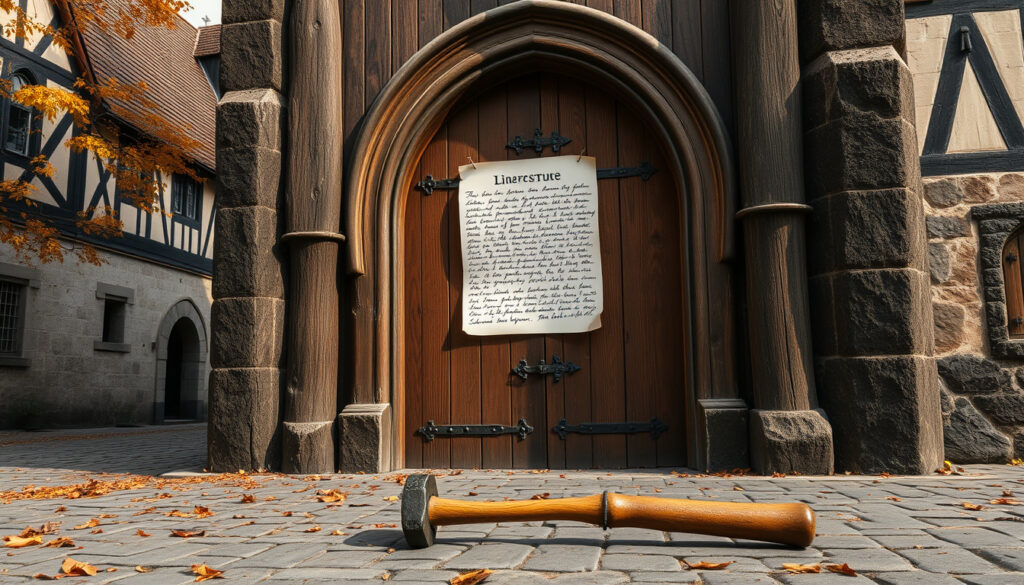
Five centuries after a German monk raised questions about his own church, people still argue about whether he was a hero, a heretic, or something in between. Martin Luther’s 95 Theses, published on 31 October 1517, became the spark of the Protestant Reformation, reshaping Europe’s politics and faith, and his story runs from a monk’s cell to a marriage that scandalized Rome, ending with the words “We are beggars. This is true.”
Born: 10 November 1483, Eisleben ·
Died: 18 February 1546, Eisleben ·
95 Theses: 31 October 1517 ·
Spouse: Katharina von Bora, married 1525 ·
Key Doctrine: Justification by faith alone
Quick snapshot
- Born 10 November 1483 in Eisleben and died 18 February 1546 in the same town (BBC History)
- Published the Ninety-five Theses on 31 October 1517 (Internet Encyclopedia of Philosophy)
- Married Katharina von Bora in 1525 (BBC History)
- Whether the theses were nailed to the church door in Wittenberg — the act is “said to have” occurred (Encyclopaedia Britannica)
- The exact wording of “Here I stand” at the Diet of Worms, likely apocryphal (Encyclopaedia Britannica)
- Reformation Day, 31 October, marks the anniversary of the Reformation’s beginning in Wittenberg (National Geographic Education)
- Luther was excommunicated in 1521 (Britannica Video)
- The Reformation spread through much of northern Europe after beginning in Germany (BBC News)
- Luther’s followers established Lutheranism after the break with Rome (Britannica Video)
Six biographical details, one pattern: Luther packed a Europe-sized controversy into three active decades, from the 95 Theses in 1517 to his death in 1546 (Encyclopaedia Britannica).
| Detail | Value |
|---|---|
| Full Name | Martin Luther |
| Lifespan | 10 November 1483 – 18 February 1546, Eisleben, Holy Roman Empire |
| Spouse | Katharina von Bora, married 1525 |
| Major Event | 95 Theses, 31 October 1517 |
| Key Doctrine | Justification by faith alone (BBC News) |
| Patron | Frederick the Wise, Elector of Saxony |
What was Martin Luther famous for?
The 95 Theses and the Reformation
- Published on 31 October 1517, the theses attacked the Church’s sale of indulgences (Internet Encyclopedia of Philosophy)
- The full title, Disputatio pro declaratione virtutis indulgentiarum, framed the document as an academic disputation (Library of Congress)
- The Library of Congress calls the text the central document of the Protestant Reformation (Library of Congress)
The Ninety-five Theses were not a manifesto. They were a list of 95 clerical abuses, chiefly relating to indulgences, prepared for debate (Library of Congress). The indulgence system, as commonly taught in educational accounts, allowed people to purchase a certificate of pardon for the punishment of sins (National Geographic Education). Luther’s intervention did not stay a local argument for long, and history educator DriveThruHistory reads the theses as “a challenge to scholars to debate matters of church policy” — an invitation, not a declaration of rupture.
Luther was a German monk, theologian, and religious reformer, and he is widely described as the catalyst of the 16th-century Protestant Reformation (Encyclopaedia Britannica). He was not the first critic of indulgences, and he was not the last. What made him different was the combination of his academic position in Wittenberg and the clarity of his core claim: the Church was selling something only God could give.
The Library of Congress calls the Disputatio pro declaratione virtutis indulgentiarum “the central document of the Protestant Reformation.” The implication: a theologian’s argument, not a political uprising, started the largest rupture in Western Christianity.
The pattern is easy to miss because Luther’s face now appears on church logos and history textbooks. In his own lifetime, though, he was a professor who forced the church to answer an uncomfortable question: if salvation is a gift, what is the pope selling?
The implication: Luther’s fame rests on the paradox that a quiet academic debate ignited a firestorm that reshaped Europe.
What were Luther’s three main ideas?
Justification by faith alone
- Salvation is a gift from God received through faith, not earned by works (BBC News)
- Luther’s breakthrough grew out of his study of Paul’s letter to the Romans (Encyclopaedia Britannica)
“Faith alone” sounds like a slogan now. For Luther it was a lifeline. As a monk he had tried to earn God’s approval through confession, fasting, and works, and it had nearly crushed him. His study of Romans convinced him that righteousness is credited to the believer by God, not achieved by effort — a conclusion that made the entire indulgence system theologically pointless.
Priesthood of all believers
- All believers have direct access to God (National Geographic Education)
- No priestly mediator is required between a Christian and God (National Geographic Education)
If salvation comes by faith, the priest’s role changes. Luther did not say clergy were useless; he said they were not the gatekeepers. National Geographic Education summarizes the shift as a direct challenge to the Catholic Church’s role as intermediary between people and God.
Authority of Scripture alone
- The Bible is the ultimate religious authority, not the Pope or church councils (BBC News)
The third pillar follows from the first two. If faith comes from God’s promise and believers meet God directly, then the church’s traditions and the pope’s rulings cannot outrank the text where that promise is recorded. Scripture becomes the court of appeal for every theological dispute — which is exactly why Luther’s own works were measured against it at the Diet of Worms.
Luther solved his own terror of judgment with a doctrine that removed the institutional church from the center of salvation. In doing so, he handed every believer a responsibility the medieval church had never asked them to carry: to read, judge, and answer for themselves.
The trade-off: Luther’s Bible-based authority solved his crisis of conscience but created a problem he did not solve — who decides when believers disagree on Scripture? That question split Protestantism almost as fast as 1517 created it.
The catch: the same ideas that unified Luther’s followers also fragmented them, because removing the pope’s authority left no single arbiter.
Who saved Martin Luther from death?
The Diet of Worms and the Edict of Worms
- Summoned to the Diet of Worms in 1521 to answer for his writings (BBC History)
- Declared an outlaw after refusing to recant (BBC History)
- Already excommunicated that year, Luther faced an imperial ban as well as a papal one (BBC History)
The showdown at Worms was the moment the conflict went from academic to existential. Emperor Charles V demanded Luther recant; Luther replied that unless convinced by Scripture or reason, he could not. The result was the Edict of Worms, which made Luther a wanted man. But the elector Frederick the Wise had other plans.
Frederick the Wise’s protection
- Frederick the Wise, Elector of Saxony, arranged a staged kidnapping to hide Luther at Wartburg Castle (Encyclopaedia Britannica)
- Luther spent about ten months in hiding at the Wartburg (Encyclopaedia Britannica)
- During that time he translated the New Testament into German (Encyclopaedia Britannica)
Frederick the Wise was a political pragmatist. He protected Luther not because he agreed with all his theology, but because Luther was a subject of Saxony and a valuable professor. The staging of the kidnapping allowed Frederick to claim he had no part in Luther’s disappearance while the reformer worked on his translation.
“I am bound by the Scriptures I have quoted and my conscience is captive to the Word of God. I cannot and will not retract anything, since it is neither safe nor right to go against conscience.” — Martin Luther, attributed words at the Diet of Worms, 1521 (likely apocryphal per Encyclopaedia Britannica)
Did Martin Luther believe in God?
Luther’s early monastic life and struggle with doubt
- Luther entered an Augustinian monastery in 1505 after a vow made during a thunderstorm (Encyclopaedia Britannica)
- He devoted himself to extreme fasting, confession, and works, but found no peace (Encyclopaedia Britannica)
Luther’s faith was not a comfortable certainty. As a young monk, he was terrified of God’s judgment. He confessed for hours, punished his body, and still felt unworthy. His spiritual director, Johann von Staupitz, urged him to trust in Christ’s mercy rather than his own efforts.
His breakthrough on justification by faith
- Through his study of Romans, Luther came to believe that salvation is a gift received through faith in Jesus Christ (Encyclopaedia Britannica)
- He described this as a “tower experience” in which he understood that God’s righteousness is given, not earned (Encyclopaedia Britannica)
Luther’s personal faith was the engine of his theology. The doctrine of justification by faith alone was not an abstract theory; it was the answer to his own anguish. “I felt myself to have been reborn and to have gone through open doors into paradise,” he later wrote.
“Luther had a deep and personal faith in God, but he wrestled with doubt and despair. His breakthrough was not a rejection of God but a new understanding of how God relates to humanity.” — Encyclopaedia Britannica biographer
Did Martin Luther love his wife?
Luther’s marriage to Katharina von Bora
- Luther married Katharina von Bora, a former nun, in 1525 (BBC History)
- The marriage scandalized Rome and many reformers (BBC History)
Luther’s marriage was a personal and political statement. By marrying a nun, he rejected the Catholic requirement of clerical celibacy and demonstrated that marriage was a holy estate. But the relationship was also genuine. Luther called Katharina “my lord” and wrote tender letters to her.
Their family life and mutual affection
- Luther and Katharina had six children (Encyclopaedia Britannica)
- Luther’s letters refer to Katharina as his “beloved” and he expressed concern for her health and well-being (Encyclopaedia Britannica)
The evidence suggests Luther loved his wife. He described her as “the most beloved of all women” and praised her management of their household. When Katharina worried about his dangerous travels, he reassured her. The marriage was a partnership of mutual affection and respect.
“To my dear lord, Martin Luther, grace and peace in Christ. I am so worried about you, my dear husband, that I cannot sleep. Please write to me.” — Katharina von Bora, in a letter to Luther (paraphrased from Encyclopaedia Britannica accounts)
What did Martin Luther say before he died?
Luther’s final written words
- Luther’s last written words were “We are beggars. This is true.” (Encyclopaedia Britannica)
- He wrote them on a scrap of paper found after his death (Encyclopaedia Britannica)
Luther’s final words reflect his theology. After a lifetime of arguing that salvation is a gift, he died admitting that even the most faithful believer approaches God empty-handed. “We are beggars” captures the humility of faith.
The context of his death in Eisleben
- Luther died on 18 February 1546 in Eisleben, the town of his birth (Encyclopaedia Britannica)
- He had traveled to Eisleben to mediate a dispute between neighboring counts (Encyclopaedia Britannica)
Luther’s death was consistent with his life. He was still working, still arguing, still trying to bring peace. He fell ill and died in a room in Eisleben, surrounded by friends. His last words, written on a scrap of paper, encapsulated his entire message: we are all beggars before God.
“We are beggars. This is true.” — Martin Luther, last written words, 1546, as recorded by Encyclopaedia Britannica
For a detailed account of his life and the events leading to the Reformation, see Martin Luthers biography.
Frequently Asked Questions
What was Martin Luther’s education?
Luther studied at the University of Erfurt, earning a bachelor’s and master’s degree, then entered the Augustinian monastery. He later studied theology at the University of Wittenberg, where he became a professor of biblical theology (Encyclopaedia Britannica).
How did Martin Luther die?
Luther died of natural causes on 18 February 1546 in Eisleben, while traveling to mediate a dispute. He had been ill for some time and his death was peaceful (Encyclopaedia Britannica).
What is the 95 Theses?
The Ninety-five Theses is a list of 95 arguments against the sale of indulgences, posted (or mailed) by Luther on 31 October 1517. It is considered the founding document of the Protestant Reformation (Library of Congress).
Why did Martin Luther leave the Catholic Church?
Luther did not intend to leave the Church; he wanted to reform it. After his excommunication in 1521 and the Edict of Worms, he was forced to operate outside the Catholic structure. His followers formed Lutheran churches (Britannica Video).
What is Lutheranism?
Lutheranism is the branch of Protestant Christianity that follows Luther’s teachings, emphasizing justification by faith alone, the authority of Scripture, and the priesthood of all believers (Britannica Video).
Did Martin Luther translate the Bible into German?
Yes, Luther translated the New Testament into German while in hiding at the Wartburg Castle in 1522. He later oversaw the translation of the Old Testament, producing a complete German Bible that had a profound impact on the German language (Encyclopaedia Britannica).
Who was Martin Luther’s wife?
Luther’s wife was Katharina von Bora, a former nun. They married in 1525 and had six children. Their marriage was a model of Protestant family life (BBC History).
What is the Diet of Worms?
The Diet of Worms was a gathering of the Holy Roman Empire in 1521 at which Luther was summoned to defend or retract his writings. He refused to recant, and the Edict of Worms declared him an outlaw (BBC History).
More related posts
 Bradley John Murdoch Dies at 67: Peter Falconio Murder and Inquest
 Teri Garr Cause of Death, Career, and Legacy: Obituary
 Callum Turner Movies and TV Shows – Complete Filmography Guide
 Black Dahlia: Meaning, Symbolism, and Murder of Elizabeth Short
 Top Job Boards Ireland: 9 Best Sites for Employers & Job Seekers
 How to Pick a Baby Name – Step-by-Step Guide for Parents
 Golden Cane Palm Care: Light, Water, Potting Tips
 Total Drama Island: Age Rating, Where to Watch & Parents Guide