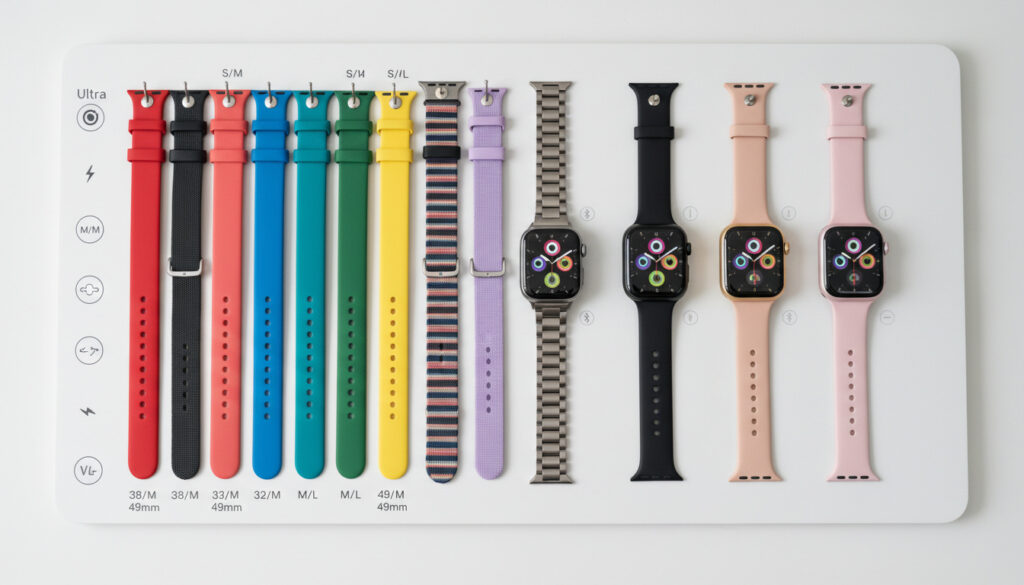
Apple Watch Bands – Sizes and Compatibility Guide
Selecting the right Apple Watch band requires understanding the compatibility system Apple uses across different case sizes and generations. Bands are not universally interchangeable, but they follow a logical grouping system that allows users to maintain their collections when upgrading devices.
Apple organizes bands into two distinct connector categories. The smaller group accommodates 38mm, 40mm, and 41mm cases, while the larger group fits 42mm, 44mm, 45mm, 46mm, and 49mm models. This distinction determines which bands work with specific Apple Watch generations, including the latest Series 11 and Ultra 3 releases.
What Are the Best Apple Watch Bands?
The optimal band depends on your specific case size and intended use. Apple and third-party manufacturers produce options across multiple materials, each designed to fit within the established compatibility framework.
| Band Category | Compatible Case Sizes | Typical Use Case | Key Characteristics |
|---|---|---|---|
| Sport/Silicone | 38–41mm or 42–49mm | Exercise, swimming | Sweat-resistant, lightweight |
| Leather | 38–41mm or 42–49mm | Professional settings | Formal aesthetic, develops patina |
| Metal Links | 38–41mm or 42–49mm | Business attire | Stainless steel construction |
| Milanese Loop | 38–41mm or 42–49mm | Daily wear | Magnetic closure, breathable |
- Bands interchange freely within two size groups: 38/40/41mm and 42/44/45/46/49mm
- Series 10–11 42mm models use the small connector, unlike Series 1–3 42mm cases
- Apple Watch Ultra bands (49mm) work with 44mm, 45mm, and 46mm cases
- Most bands offer S/M and M/L length variations for different wrist sizes
- Third-party options exist but fit quality varies by manufacturer
- Upgrading from Series 10 to Series 11 preserves existing band compatibility
- Ultra 1 and Ultra 2 bands remain compatible with Ultra 3
| Apple Watch Model | Case Size | Compatible Band Sizes |
|---|---|---|
| Series 1–3 | 38mm | 38mm, 40mm, 41mm |
| Series 4–6, SE | 40mm | 38mm, 40mm, 41mm |
| Series 7–9 | 41mm | 38mm, 40mm, 41mm |
| Series 10–11 | 42mm* | 38mm, 40mm, 41mm, 42mm |
| Series 1–3 | 42mm | 42mm, 44mm, 45mm |
| Series 4–6, SE | 44mm | 42mm, 44mm, 45mm |
| Series 7–9 | 45mm | 44mm, 45mm, 46mm, 49mm |
| Series 10–11 | 46mm | 44mm, 45mm, 46mm, 49mm |
| Ultra 1–3 | 49mm | 44mm, 45mm, 46mm, 49mm |
*Series 10–11 42mm uses the small connector (differs from Series 1–3 42mm).
What Size Apple Watch Band Do I Need?
Determining the correct band size involves two factors: the connector size (determined by your watch case) and the band length (determined by your wrist circumference). Apple and third-party manufacturers typically produce bands in two length options to accommodate different wrist dimensions.
Are Apple Watch Bands Interchangeable?
According to Apple’s official support documentation, bands are interchangeable within designated size groups. Bands for 38mm, 40mm, and 41mm cases work with each other, while bands for 42mm, 44mm, and 45mm cases share compatibility. The newer 46mm cases accept bands from 44mm, 45mm, and 46mm models.
Can I Use Different Bands for Apple Watch Models?
Yes, provided they share the same connector size group. Research confirms that the system organizes into two practical categories: a smaller group (38mm, 40mm, 41mm) and a larger group (42mm, 44mm, 45mm, 46mm, 49mm). This means a 41mm Series 9 band works on a 38mm Series 3, and a 45mm Series 9 band fits a 49mm Ultra 2.
S/M (Small/Medium) fits wrists measuring 130–180mm (5.1–7.1 inches). M/L (Medium/Large) accommodates 160–210mm (6.3–8.3 inches). When between sizes, choose M/L for more slack or S/M for a snug fit.
Understanding these compatibility boundaries helps when browsing the Palm Beach Locations Guide for retail options, as inventory varies by region.
How Do I Change an Apple Watch Band?
Apple typically provides mechanism instructions through their official support channels.
Generally, the process involves pressing a release button on the back of the watch case while sliding the band out horizontally. Installation requires aligning the new band with the slot and sliding it in until a click indicates secure attachment. Users should ensure the band orientation matches the case (top to top, bottom to bottom) before sliding.
Always verify whether your specific case uses the small or large connector before purchasing. Series 10–11 42mm models use the small connector (38–41mm group), unlike the original Series 1–3 42mm cases which use the large connector (42–49mm group).
Where Can I Buy Apple Watch Bands?
Apple Watch bands are available through Apple’s official retail channels, authorized resellers, and third-party manufacturers. Apple’s official store offers the complete range of first-party options, while numerous third-party vendors provide alternative materials and designs.
How Much Do Apple Watch Bands Cost?
Specific pricing data for official Apple bands and third-party alternatives was not included in the available research sources. Costs vary significantly based on material (silicone, leather, metal), brand (Apple vs. third-party), and retailer.
When evaluating the 2025 GMC Yukon Denali Pricing Specs and Reviews, consumers often apply similar comparison shopping principles to watch bands, balancing official manufacturer warranties against third-party value propositions.
Third-party band quality varies significantly by manufacturer. While many offer compatible fit and functionality, construction durability and material safety standards may differ from official Apple products. Verify reviews and specifications before purchase.
How Have Apple Watch Band Sizes Evolved?
- 2015: Original Apple Watch launched with 38mm and 42mm cases, establishing the two-connector system.
- 2018: Series 4 introduced 40mm and 44mm sizes, maintaining compatibility with existing 38mm and 42mm bands respectively.
- 2021: Series 7 brought 41mm and 45mm options, fitting existing small and large connector bands.
- 2022: Apple Watch Ultra introduced 49mm case size, compatible with 44mm and 45mm bands.
- 2024: Series 10 launched 42mm and 46mm cases. Notably, the 42mm Series 10 uses the small connector, differing from the original Series 1–3 42mm.
- 2025: Series 11 and Ultra 3 maintained existing compatibility, ensuring bands from Series 10 and earlier Ultra models remain interchangeable.
What Is Confirmed About Band Compatibility?
| Established Information | Information Remaining Unclear |
|---|---|
| Two connector size groups exist: small (38/40/41mm) and large (42/44/45/46/49mm) | Specific pricing tiers for official versus third-party bands |
| S/M fits 130–180mm wrists; M/L fits 160–210mm | Long-term durability comparisons between specific material types |
| Ultra 1/2/3 bands interchange with 44/45/46mm cases | Water resistance ratings for specific third-party silicone options |
| Series 10–11 42mm uses small connector (not large like Series 1–3 42mm) | Comprehensive quality ratings for third-party manufacturers |
| Upgrading Series 10 to 11 preserves band compatibility | Material safety certifications across all third-party vendors |
Why Does Band Sizing Matter?
The compatibility system exists because Apple Watch bands use mechanical locking mechanisms sized to specific case dimensions. The connector width determines physical fit, while band length ensures proper sensor contact with the wrist for heart rate monitoring and blood oxygen readings.
Understanding these technical constraints prevents purchasing errors, particularly when shopping for discontinued models or legacy bands. Apple’s comparison tools provide additional guidance for specific model differences. Understanding these technical constraints prevents purchasing errors, particularly when shopping for discontinued models or legacy bands, and for more fun ideas, check out these Elf on the Shelf ideas. Elf on the Shelf ideas
What Do Official Sources Say?
Bands for 38mm, 40mm, and 41mm cases are compatible with each other. Bands for 42mm, 44mm, and 45mm cases are compatible with each other. Bands for 46mm cases are compatible with 44mm, 45mm, and 46mm cases.
— Apple Support Documentation
If you’re upgrading from Series 10 to Series 11, your existing bands remain compatible. Ultra 1/2 bands work with Ultra 3, and 49mm bands interchange with 44/45/46mm cases and vice versa.
— Compatibility Analysis 2025
What Should You Check Before Buying?
Confirm your Apple Watch case size and generation, verify whether it uses the small or large connector group, measure your wrist circumference to select between S/M and M/L lengths, and check compatibility charts when mixing generations. This verification ensures proper fit and maintains the watch’s health monitoring accuracy.
Frequently Asked Questions
What are the different types of Apple Watch bands?
Primary categories include sport bands (silicone), leather loops and buckles, metal Milanese loops, link bracelets, and nylon sport loops. Each type comes in both connector sizes (small 38–41mm and large 42–49mm) to fit respective case models.
Are third-party Apple Watch bands good?
Quality varies significantly by manufacturer. While many third-party bands offer compatible fit within the standard size groups, construction durability, material safety, and connector precision may differ from official Apple products. Verify specifications and user reviews before purchasing.
Will my Series 10 bands work with Series 11?
Yes. Upgrading from Series 10 to Series 11 maintains full band compatibility. The 46mm and 42mm sizes retain the same connector specifications, allowing existing band collections to transfer seamlessly to the new generation.
What is the difference between the two 42mm sizes?
Series 1–3 42mm cases use the large connector (compatible with 42/44/45mm bands), while Series 10–11 42mm cases use the small connector (compatible with 38/40/41/42mm bands). This distinction is critical when purchasing bands for older versus newer 42mm models.
Do Apple Watch Ultra bands fit regular models?
Yes. The 49mm Ultra bands fit 44mm, 45mm, and 46mm cases. Conversely, 44mm, 45mm, and 46mm bands fit the 49mm Ultra cases. This interchangeability works because they share the large connector size group.
How do I choose between S/M and M/L band sizes?
S/M fits wrists 130–180mm (5.1–7.1 inches) while M/L accommodates 160–210mm (6.3–8.3 inches). When measurements fall between these ranges, select M/L for a looser fit or S/M for tighter contact.
More related posts
 Jackson Wang: Biography, Age, Net Worth, Relationship
 Kareena Kapoor: Biography, Age, Marriage, Net Worth
 Optus Recharge Number – Top Up Prepaid via Phone, App & More
 Julia Butters: Biography, Career & Latest Updates
 Andy Garcia: Twin, Friend’s Death, and Personal Life
 Rosie Huntington-Whiteley & Jason Statham: Why Unmarried
 Woolworths Toilet Paper: Septic Safe, Cost & Best Options
 Peter Dinklage: Health, Net Worth, Family, and Career