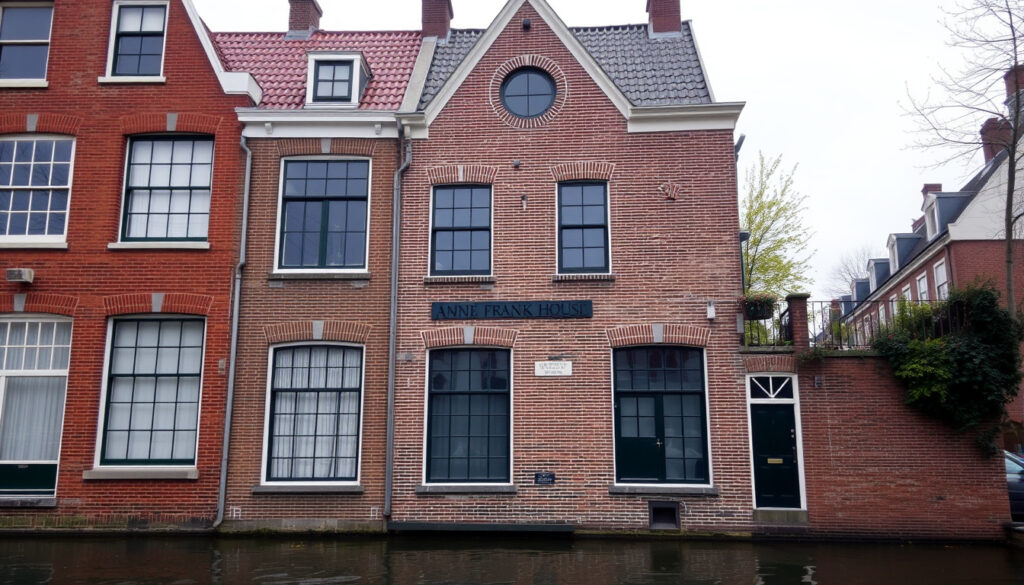
Anne Frank House: Tickets, Tours, History, and Visitor Guide
Few artifacts from World War II carry the emotional weight of Anne Frank’s diary, and the Anne Frank House in Amsterdam brings that diary to life by preserving the Secret Annex where she and seven others hid for over two years. Each year, more than 1.2 million visitors walk through the same hidden doorway behind the bookcase (Anne Frank House (official museum site)).
Year opened as museum: 1960 ·
Annual visitors: over 1.2 million ·
Location: Prinsengracht 263, Amsterdam ·
Days Anne Frank hid: 761
Quick snapshot
- Tickets sold only through the official website, not at the door (Anne Frank House (official ticketing page))
- Audio tour is included in every visit (Anne Frank House (ticket options))
- A standard visit takes about one hour (Anne Frank House (visit duration))
- Exact date of Anne Frank’s death (February or March 1945) (Anne Frank House (her life story))
- Anne Frank’s last spoken words are not recorded, only survivor approximations (Anne Frank House (her final months))
- Exact number of books behind the rotating bookcase (three reproductions exist) (Anne Frank House (the Secret Annex))
- 1960: Anne Frank House opens as a museum (Anne Frank House (about the house))
- August 4, 1944: hiding place raided, family arrested (Anne Frank House (the arrest))
- Book tickets six weeks ahead when they become available (Anne Frank House (ticket release))
- Explore the free virtual tour on the official site (Anne Frank House (virtual tour))
Six key facts about the Anne Frank House tell a story of history, preservation, and visitor access.
| Fact | Detail |
|---|---|
| Year built | 1635 |
| Year became museum | 1960 |
| Hiding period | July 6, 1942 – August 4, 1944 |
| Number of people in hiding | 8 |
| Visitors per year | 1.2 – 1.3 million |
| UNESCO Memory of the World | Anne Frank’s diary inscribed in 2009 |
The building at Prinsengracht 263 was constructed in 1635, nearly three centuries before the hiding period (Wikipedia (Anne Frank House)).
Why is Anne Frank House so famous?
The significance of the Secret Annex
The Anne Frank House is the actual building where Anne Frank and her family hid from Nazi persecution. The Secret Annex — four rooms behind a movable bookcase — has been preserved exactly as it was when the eight people lived there (Anne Frank House (the Secret Annex)). Visitors walk through the same spaces Anne described in her diary, making the history tangible.
Anne Frank’s diary and its global impact
Anne Frank’s diary, published by her father Otto in 1947, is one of the most‑read books in the world, translated into over 70 languages (Anne Frank House (the diary)). It gives a personal, everyday account of life in hiding and has become a symbol of the human cost of the Holocaust.
The museum as a Holocaust memorial
Beyond the annex, the museum operates as a memorial and educational center. Exhibitions place the Frank family’s story within the broader context of the Holocaust and antisemitism then and now.
The Anne Frank House is famous not because of marketing but because it preserves a site where a teenager’s words turned an abstract tragedy into a personal, unforgettable story.
The emotional authenticity of the site is unmatched by any other Holocaust memorial.
Is Anne Frank’s house actually her house?
The distinction between the Anne Frank House and the Frank family home
The Frank family lived in Amsterdam at Merwedeplein 37 before going into hiding. The building at Prinsengracht 263 was not their home — it housed Otto Frank’s business, Opekta, on the ground floor. The family moved into the hidden back annex because it was concealed behind the office space (Anne Frank House (the building)).
Prinsengracht 263: the office and hiding place
So the Anne Frank House is the building where Anne hid and wrote her diary, not the house where she lived before. Calling it “Anne Frank’s house” is a common shorthand, but the museum preserves the hiding place, not her family home.
Bottom line: The Anne Frank House is the hiding place behind Otto Frank’s business, not the family’s pre‑war home. Visitors should understand they are seeing the Secret Annex, not a residential house.
Can you visit the real Anne Frank House?
Ticket information and official website
Yes, the Anne Frank House is open to the public. Tickets are sold exclusively through the official website, never at the door. All tickets become available every Tuesday at 10:00 CEST for visits six weeks later (Anne Frank House (ticket release schedule)). Tickets are non‑transferable and cannot be exchanged or refunded (Anne Frank House (ticket policy)).
What visitors experience inside the museum
Once inside, visitors follow a one‑way route through the warehouse, the offices, the annex, and finally the exhibition space. An audio guide (included) provides context for each room. The standard museum visit takes approximately one hour (Anne Frank House (visit duration)).
Virtual tour alternatives
A virtual tour of the Anne Frank House is available on the official website, allowing anyone to explore the space remotely (Anne Frank House (virtual tour)).
Commercial tour operators that claim to provide “Anne Frank House tours” do not actually grant access to the museum. Buyers who purchase third‑party packages risk arriving without a valid ticket (Anne Frank House (official warning)).
The implication: only tickets bought directly from the museum guarantee entry; any reseller is a gamble.
How long does it take to go through the Anne Frank house in Amsterdam?
Average visit duration
A typical visit lasts about 60 to 90 minutes, depending on how long you stop at each exhibit. The museum estimates one hour for the standard self‑guided route (Anne Frank House (visit duration)). Once inside, you can stay as long as you like (Anne Frank House (no time limit)).
Tips for a smoother visit
- Book your ticket as soon as the batch drops (Tuesday 10:00 CEST, six weeks ahead).
- Choose the introductory program (€7 extra, 30 minutes, in English) for deeper context before entering the annex.
- Arrive at the entrance on Westermarkt 20 — around the corner from Prinsengracht 263 (Anne Frank House (entrance location)).
- Use tram 13 or 17 to the Westermarkt stop; it’s about a 20‑minute walk from Amsterdam Central Station (Anne Frank House (public transport)).
What to see in each room
The route passes the warehouse (where helpers worked), the office, the annex’s main rooms, and ends with a contemporary exhibition. The audio guide highlights details like the pencil marks on the wall where Anne’s height was recorded.
Bottom line: A visit takes around one hour, but you can linger longer. The key to a stress‑free visit is booking early and knowing the logistics beforehand.
What did Anne Frank say before she died?
Anne Frank’s final diary entry
Anne Frank’s last diary entry is dated August 1, 1944 — just three days before the arrest. In it she reflects on her dual nature: “I twist my heart round again, so that the bad is on the outside and the good is on the inside, and keep on trying to find a way of becoming what I would so like to be” (Anne Frank House (diary entry)). The diary ends mid‑sentence.
Last known words and historical ambiguity
Her exact last spoken words are not documented. Survivors of Bergen‑Belsen recalled that Anne expressed hope in humanity, but no verbatim record exists (Anne Frank House (her final months)). Many commonly attributed phrases — such as “I still believe that people are really good at heart” — come from her diary, not her final moments.
Why did Anne Frank call her daddy Pim?
Anne used “Pim” as an affectionate nickname for her father Otto Frank. The nickname appears multiple times in her diary and reflects the close bond between them (Anne Frank House (Otto Frank)).
What were Anne Frank’s last words before she died?
Survivors recall Anne expressing hope in humanity, but no exact last words are documented. Commonly attributed phrases lack reliable sources and likely originate from her diary rather than her spoken final moments (Wikipedia (Anne Frank)).
Misinformation and myths
Internet rumors often quote fabricated last words. The Anne Frank House and historians caution that only survivor approximations exist, and even those conflict on details.
Upsides
- Authentic preservation of the Secret Annex — you see the real rooms.
- Powerful educational experience that connects history to a personal story.
- Central Amsterdam location, easy to reach by public transport.
- Audio tour included, providing rich context without extra cost.
Downsides
- Tickets sell out fast; booking weeks ahead is mandatory for many dates.
- No on‑site ticket sales — you must plan online in advance.
- Limited wheelchair accessibility in parts of the historic building.
- Some visitors find the queue and crowd management frustrating during peak times.
Step‑by‑step guide to visiting the Anne Frank House
- Step 1: Book your tickets — Go to the official website (annefrank.org) every Tuesday at 10:00 CEST for tickets six weeks later. Choose between a standard visit (€16 for adults) or the introductory program (€23).
- Step 2: Plan your arrival — The entrance is at Westermarkt 20, not Prinsengracht 263. Use tram 13 or 17 to Westermarkt, or walk 20 minutes from Amsterdam Central Station.
- Step 3: Check special hours — The museum has exceptions on 1 January, King’s Day (27 April), 25 December, and 31 December. On 20 September 2026 it opens 9:00–17:00 (Anne Frank House (opening hours)).
- Step 4: Take the audio tour — The included audio guide leads you through each room. It’s available in multiple languages and adds critical context.
- Step 5: Spend time in the exhibition — After the annex, the modern exhibition explores the wider history of the Holocaust and contemporary issues.
Following these steps in order ensures a smooth visit and minimizes last‑minute surprises.
Timeline
- 1635 — Building at Prinsengracht 263 constructed (Wikipedia (Anne Frank House)).
- July 6, 1942 — Frank family moves into the Secret Annex (Wikipedia (Anne Frank timeline)).
- August 4, 1944 — Hiding place raided; family arrested (Anne Frank House (the arrest)).
- February/March 1945 — Anne Frank dies at Bergen‑Belsen (Anne Frank House (her life story)).
- 1960 — Anne Frank House opens as a museum (Anne Frank House (museum history)).
- 1999 — Major renovation and expansion completed (Wikipedia (Anne Frank House renovation)).
The chronological sequence shows how a 17th‑century merchant building became a world‑famous memorial.
What’s confirmed — and what remains unclear
Confirmed facts
- Anne Frank hid in the Secret Annex at Prinsengracht 263 (Anne Frank House (the Secret Annex)).
- The Anne Frank House is a museum open to the public (Anne Frank House (ticketing)).
- The diary was published by Otto Frank in 1947 (Anne Frank House (the diary)).
- Anne Frank died in Bergen‑Belsen (Anne Frank House (her life story)).
What’s less certain
- Exact date of Anne Frank’s death (February or March 1945) (Anne Frank House (her life story)).
- Anne Frank’s last spoken words (no recorded evidence) (Anne Frank House (her final months)).
- The precise number of original books behind the rotating bookcase (three reproductions) (Anne Frank House (the Secret Annex)).
- The exact number of visitors per year fluctuates; the official estimate is 1.2–1.3 million (Anne Frank House (ticketing)).
The mix of certain and uncertain facts underscores the historical gaps that remain despite thorough documentation.
Voices from the diary
“In spite of everything, I still believe that people are really good at heart.”
— Anne Frank, diary entry dated July 15, 1944 (Anne Frank House (diary quotations))
Otto Frank later said that after reading the diary he “knew the great desire of Anne to become a writer and to publish a book.” He resolved to fulfill that wish.
— Otto Frank, quoted by the Anne Frank House (Anne Frank House (Otto Frank))
For visitors to Amsterdam, the Anne Frank House is not just a museum — it’s an experience that requires planning. If you don’t book tickets weeks ahead, you may miss out entirely. And if you do go, you’ll walk through a space that turns ink‑and‑paper history into three‑dimensional reality.
angelamobilemakeup.com, tickets-amsterdam.com, youtube.com, community.ricksteves.com, incredibleamsterdam.com, tripadvisor.com
For those planning a visit, securing official Anne Frank House tickets well in advance is essential due to high demand.
Frequently asked questions
How do I get tickets for the Anne Frank House?
Official tickets are sold only at annefrank.org. They become available every Tuesday at 10:00 CEST for visits six weeks later.
Are there guided tours at the Anne Frank House?
The museum offers an introductory program (€7 extra, 30 minutes, in English) that includes a guide before you explore the annex on your own. The standard visit is self‑guided with an audio tour.
Is the Anne Frank House accessible for wheelchair users?
Parts of the historic building have limited accessibility. The museum provides details on its accessibility page. It is recommended to contact the museum in advance.
Can I take photos inside the Anne Frank House?
Photography is not allowed in the Secret Annex to preserve the original atmosphere and respect other visitors. Some areas of the exhibition may permit photos.
How do I get to the Anne Frank House by public transport?
Tram 13 or 17 to the Westermarkt stop. The entrance is at Westermarkt 20, about a 20‑minute walk from Amsterdam Central Station (Anne Frank House (directions)).
Are there discounts for students at the Anne Frank House?
Student cards do not offer a discount. Reduced rates are available for children (10–17: €7), Museumkaart holders (€1), ICOM card holders (€1), and European Youth Card holders (€7).
Is the Secret Annex the original or a replica?
The Secret Annex is original — the rooms, the bookcase, the walls, and many objects are authentic. After the war, the space was restored and furnished with period pieces based on Anne’s descriptions and photographs.
These answers cover the most common practical concerns visitors have before planning a trip.
More related posts
 Under Bed Storage: IKEA, Wheels & Ireland Options
 Justin Longmuir: Biography, Coaching Career, and Family
 Izak Rankine: Biography, Career, Contract & Injury Updates
 Downton Abbey Movie: Complete Guide to Watching the Films
 Craig Bellamy: Playing Career, Coaching, Net Worth & Personal Life
 Alex Consani: Transgender Model, TikTok Star, and Trailblazer
 Fred Durst: Biography, Controversies & Net Worth
 Malin Akerman: Age, Kids, Height, Fitness, and Net Worth