Isaac Newton: Genius, Faith, and Scientific Legacy
Few figures in science carry a reputation as weighty as Isaac Newton’s, yet the man behind the Principia was far stranger than the marble statue suggests. He spent as much energy decoding biblical prophecy and alchemical recipes as he did charting the orbits of planets.
Born: 4 January 1643 (OS 25 December 1642) · Died: 31 March 1727 · Known For: Laws of motion, universal gravitation, calculus · Alma Mater: Trinity College, Cambridge · Notable Work: Philosophiæ Naturalis Principia Mathematica · Awards: Knighted 1705
Quick snapshot
- Born at Woolsthorpe, Lincolnshire, on 25 December 1642 (Julian), or 4 January 1643 in the modern calendar (Royal Society biographical archive).
- Admitted to Trinity College, Cambridge, in 1661 at about age 18 (Newton Project, University of Oxford).
- Published Philosophiæ Naturalis Principia Mathematica in 1687 (Cambridge University Archive Search).
- Newton’s last words are disputed; the famous “seashore” line survives only through secondhand accounts (Wikipedia biography).
- Retrospective IQ scores for Newton and Einstein are speculative reconstructions, not measured results (Wikipedia biography).
- His exact private theology, especially on the Trinity, remains a matter of historical interpretation (Stanford Encyclopedia of Philosophy).
- 1665–1666: Cambridge closed for plague, and Newton worked at Woolsthorpe on what became optics, mechanics, and gravity (Isaac Newton Institute).
- 1669: appointed Lucasian Professor of Mathematics at Cambridge (Cambridge University Archive Search).
- 1703: became President of the Royal Society (Isaac Newton Institute).
- Historians continue to reassess Newton’s alchemical and theological manuscripts as central, not marginal, to his thought (Stanford Encyclopedia of Philosophy).
- The private writings are now far easier to study thanks to digitized archival collections such as the Newton Project (Newton Project, University of Oxford).
Isaac Newton at a Glance
Seven key facts, one pattern: the public Newton and the private Newton were not the same person.
| Label | Value |
|---|---|
| Full Name | Sir Isaac Newton (Isaac Newton Institute) |
| Born | 4 January 1643 (OS 25 December 1642) (MacTutor History of Mathematics) |
| Died | 31 March 1727 (Wikipedia biography) |
| Known For | Laws of motion, universal gravitation, calculus (MacTutor History of Mathematics) |
| Education | Trinity College, Cambridge (Newton Project, University of Oxford) |
| Notable Work | Philosophiæ Naturalis Principia Mathematica (1687) (Cambridge University Archive Search) |
| Awards | Knighted 1705; FRS 1672 (Isaac Newton Institute) |
The pattern is clear: the same man who systematized planetary motion also filled notebooks with theology. The public career and the private archive have to be read together.
10 Lines About Isaac Newton: A Brief Biography
If you need the short version, here it is in ten compressed statements.
- Newton was an English mathematician and physicist (Institute for Creation Research science profile).
- He was born in Woolsthorpe, Lincolnshire, in 1643 by the modern calendar.
- He attended Grantham Grammar School before Cambridge.
- He entered Trinity College, Cambridge, in 1661.
- He became Lucasian Professor of Mathematics in 1669.
- During 1665–1666, the plague years, he produced formative work on calculus, optics, and gravity.
- He published the Principia in 1687.
- He was elected to the Royal Society in 1672 and became its President in 1703.
- He was knighted by Queen Anne in 1705.
- He died in 1727 and was buried in Westminster Abbey.
Early Life and Education
- Newton’s early education began at Grantham Grammar School before he moved on to Cambridge (Institute for Creation Research science profile).
- He was admitted to Trinity College, Cambridge, on 5 June 1661, “in the eighteenth year of his age” (Newton Project, University of Oxford).
- He was elected a Fellow of Trinity in 1667 and appointed Lucasian Professor in 1669 (MacTutor History of Mathematics).
Key Inventions and Discoveries
- Calculus: Newton developed his method of fluxions in the mid-1660s, sharing credit with Leibniz (Wikipedia biography).
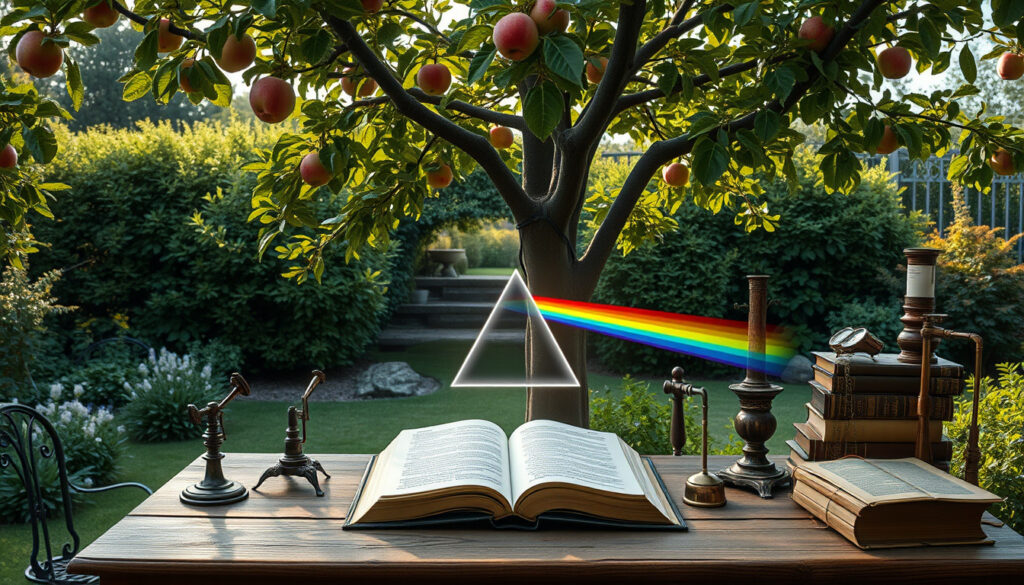
- Optics: he demonstrated that white light contains colored rays and built a reflecting telescope, publishing his optics research in 1704 (MacTutor History of Mathematics).
- Gravity and motion: the Principia of 1687 set out the laws of motion and universal gravitation (Isaac Newton Institute).
How Old Was Isaac Newton When He Entered University?
Newton was 18 when he was admitted to Trinity College, Cambridge. The college register records the date as 5 June 1661, “in the eighteenth year of his age” (Newton Project, University of Oxford).
Newton’s Education at Cambridge
- He became a Fellow of Trinity in 1667 (Isaac Newton Institute).
- He was appointed Lucasian Professor of Mathematics in 1669 (MacTutor History of Mathematics).
- He remained at Cambridge, lecturing in most years, until 1696 (Isaac Newton Institute).
The Year of the Plague and the Annus Mirabilis
- Cambridge closed in 1665 because of plague, and Newton went home to Woolsthorpe for about two years (Royal Society biographical archive).
- He later described 1665–1666 as “the prime of my age for invention” (Isaac Newton Institute).
- In that period he worked on calculus, optics, and gravity (MacTutor History of Mathematics).
Why this matters: Newton did not become Newton in a lecture hall. The plague closure forced him into isolation, and the Woolsthorpe months became the most productive stretch of his life.
Who Had a Higher IQ: Einstein or Newton?
The honest answer is that nobody knows. No standardized IQ test was available to Newton, and Einstein never submitted to one, so every number attached to either man is a retrospective guess.
Einstein’s Estimated IQ
- Popular estimates have placed Einstein around 160, but the number is a post hoc guess rather than a documented test result (Wikipedia biography).
- Einstein’s annus mirabilis papers of 1905 are the usual anchor for comparisons.
Newton’s Intellectual Legacy
- Modern scholarship describes Newton as one of the foremost scientific intellects of all time (Isaac Newton Institute).
- His mathematical and physical work was already revolutionary before he turned 25 (MacTutor History of Mathematics).
- His law of universal gravitation unified the physics of Earth and sky (Cambridge University Archive Search).
The Difficulty of Retrospective IQ Measurement
- Retrospective IQ scoring compares people across centuries with different schools, languages, and scientific problems (Stanford Encyclopedia of Philosophy).
- The exercise measures cultural prominence as much as cognitive capacity (Wikipedia biography).
No IQ test was ever administered to Newton or Einstein, so a “190 vs. 160” scoreboard says more about our love of rankings than about either man’s mind.
Three rows, one takeaway: the Newton–Einstein IQ battle is a popular game with no official scorecard.
| Comparison | Einstein | Newton |
|---|---|---|
| Formal IQ test taken? | No | No |
| Retrospective estimate | Around 160 | Around 190 |
| Field-changing work | Relativity and quantum theory | Laws of motion, universal gravitation (Isaac Newton Institute) |
| Published masterwork | Annus Mirabilis papers (1905) | Principia Mathematica (1687) (Cambridge University Archive Search) |
What Did Isaac Newton Say About Jesus and God?
Newton’s God was real, but it was not the God of the Anglican catechism.
Newton’s Arianism and Rejection of the Trinity
- Newton privately rejected the traditional doctrine of the Trinity (Wikipedia biography).
- Historians describe him as a devout but unorthodox Christian (Stanford Encyclopedia of Philosophy).
- An anti-Trinitarian public stance would have endangered a Cambridge career in Restoration England.
Newton’s Views on the Bible
- He spent years correlating biblical prophecy with historical events (Washington University in St. Louis Physics).
- His private archive includes extensive theological notes, biblical chronology, and prophecy studies (Stanford Encyclopedia of Philosophy).
- Contrary to the stereotype of a purely secular physicist, he treated scripture as a legitimate field of systematic inquiry.
Einstein and God
- Einstein used religious language for the order of the cosmos, while Newton used it for prophecy and divine intervention in history.
- Both men rejected a purely mechanical world picture, though their conclusions pointed in very different directions.
Newton wrote more about theology and biblical chronology than most people realize, yet the “secular scientist” stereotype survives because his private manuscripts were barely studied until the twentieth century.
The implication: Newton’s science and his faith were two instruments for reading the same divine author, and separating them distorts the biography.
What Is Isaac Newton’s Most Famous Quote?
The quote everyone remembers is the one Newton aimed at Robert Hooke.
“If I have seen further…”
- “If I have seen further it is by standing on the shoulders of Giants” appeared in a letter to Robert Hooke in 1675 (Newton Project, University of Oxford).
- The humble phrasing masked a ferocious priority dispute over optics (Stanford Encyclopedia of Philosophy).
Other Notable Quotes
- “I can calculate the movement of the stars, but not the madness of men” is widely attributed to Newton, though it survives as an anecdote rather than a dated manuscript (Washington University in St. Louis Physics).
- Newton’s most reliably documented self-assessment describes 1665–1666 as “the prime of my age for invention” (Isaac Newton Institute).
Context of the Quotes
- The “standing on the shoulders of Giants” phrase suited Newton’s public persona, but his letters show a combative defender of his own priority.
- Courts, universities, and rival scientists shaped how he framed his achievements; the quotes are as strategic as they are memorable.
What this means: Newton’s most quoted line is real, but it was written during a fight. Read his letters in context and you see a man who could be generous in print and ruthless in practice.
Timeline: Key Dates in Isaac Newton’s Life
Six dates, one pattern: the key burst of invention came early, followed by a long public career of publication and duty.
| Date | Event | Source |
|---|---|---|
| 1643 | Born in Woolsthorpe, Lincolnshire | MacTutor History of Mathematics |
| 1661 | Entered Trinity College, Cambridge | Newton Project, University of Oxford |
| 1665–1666 | Annus Mirabilis — calculus, optics, gravity | Royal Society biographical archive |
| 1687 | Publication of Principia Mathematica | Cambridge University Archive Search |
| 1705 | Knighted by Queen Anne | Institute for Creation Research science profile |
| 1727 | Died in London; buried in Westminster Abbey | Wikipedia biography |
The pattern: the Woolsthorpe years did the heavy lifting, and the rest of Newton’s career was spent publishing, defending, and translating those ideas into institutional power.
Confirmed Facts vs. What’s Unclear
Confirmed facts
- Born in 1643 Gregorian / 25 December 1642 Julian (Royal Society biographical archive).
- Attended Cambridge from 1661 (Newton Project, University of Oxford).
- Published the Principia in 1687 (Cambridge University Archive Search).
- Died in 1727 and was buried in Westminster Abbey (Wikipedia biography).
What’s unclear
- Last words are disputed and survive only in anecdotal accounts (Wikipedia biography).
- IQ estimates for Newton and Einstein are speculative reconstructions (Wikipedia biography).
- The precise fine print of his anti-Trinitarian theology remains debated among historians (Stanford Encyclopedia of Philosophy).
- The apple story cannot be independently verified; the reliable record shows he worked on gravity during the Woolsthorpe years (Washington University in St. Louis Physics).
The split is the story: what we know about Newton’s work is far more secure than the folklore about his personality.
Quotes That Survive Newton
If I have seen further it is by standing on the shoulders of Giants.
Isaac Newton, letter to Robert Hooke, 1675 (Newton Project, University of Oxford)
I was in the prime of my age for invention.
Isaac Newton, quoted by the Isaac Newton Institute
Admitted to Trinity College, Cambridge, on 5 June 1661, in the eighteenth year of his age.
Trinity College admission record, transcribed by the Newton Project
What to watch: the quotes that survive are the ones that fit our image of Newton — the humble genius and the lonely inventor. The archive also preserves a sharper, angrier Newton who fought for priority all his life.
Summary
Newton’s legacy is bigger than the apple story and the three laws. He ran the Royal Society, wrote theology in secret, and built a physics that defined classical mechanics for centuries. For anyone who grew up on the clean textbook portrait, the choice is clear: keep the equations, but drop the stereotype of the purely secular scientist — or you will end up reading the most famous mind in science with half his ideas missing.
emlo-portal.bodleian.ox.ac.uk, fitzmuseum.cam.ac.uk, conservapedia.com
Frequently asked questions
Did Isaac Newton have a wife?
No. He never married. The biographical record kept by the Royal Society biographical archive describes a life organized around Cambridge, the Royal Society, and his own research.
Why did Newton keep his religious views secret?
Publicly defending an anti-Trinitarian position in Restoration England risked career and legal trouble. The Stanford Encyclopedia of Philosophy notes that Newton’s theology ran parallel to his science and remained largely private.
How did Isaac Newton die?
He died in London on 31 March 1727 and was buried in Westminster Abbey. The MacTutor History of Mathematics records the standard dates used by biographers.
What is the apple story about Newton?
The story claims a falling apple at Woolsthorpe triggered his thinking on gravity. The Royal Society biographical archive confirms he spent two years at Woolsthorpe during the plague, but the apple detail itself is a later anecdote rather than a dated scientific note.
What did Newton discover about light?
He demonstrated that white light can be split into a spectrum of colors and constructed a reflecting telescope. His optics research was published in 1704, a date held by the Cambridge University Archive Search.
What are Newton’s three laws of motion?
The laws of inertia, acceleration, and action–reaction appeared in the Principia. The Isaac Newton Institute treats the Principia as the founding text of classical mechanics.
Was Isaac Newton a Freemason?
No credible contemporary record places Newton in a Masonic lodge. The institutional biographies collected by the Royal Society biographical archive describe a public career centered on Cambridge and the Royal Society, not on secret societies.
What is Newton’s connection to the Royal Society?
He was elected a Fellow in 1672 and served as its President from 1703 until his death in 1727. The Isaac Newton Institute records both appointments.
More related posts
 Olanzapine Side Effects – Common, Serious and Long-Term Risks
 Tim Allen: Conviction, ADHD, Family & Latest Controversies
 Microsoft Teams Login – How to Sign In on Web, Desktop, Mobile
 Danielle Brooks: Biography, Husband, Children, Ethnicity & More
 Michael J. Fox: Parkinson’s Stage and Life Expectancy
 Andrew Symonds: Death, Career and Life of a Cricket Legend
 Jackson Wang: Biography, Age, Net Worth, Relationship
 Janet Jackson: Kids, Surgery, Net Worth, and Life Today