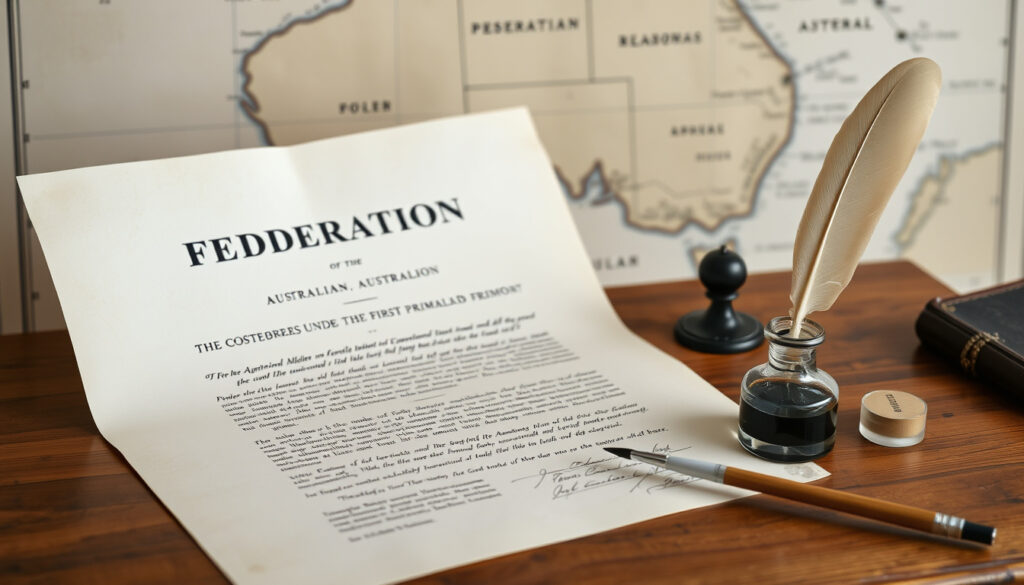
Edmund Barton: Australia’s First Prime Minister
Few figures in Australian history spark a conversation as split as Edmund Barton. He’s the man who united six colonies into a nation and then, as the first Prime Minister, wrote the rules that kept many people out.
Born: 18 January 1849 ·
Died: 7 January 1920 ·
Prime Minister term: 1901–1903 ·
Political Party: Protectionist Party ·
Spouse: Jane Mason Ross ·
Children: 6
Quick snapshot
- First Prime Minister of Australia (1 Jan 1901 – 24 Sept 1903) (National Museum of Australia)
- Leading figure in Federation and a drafter of the Constitution (Parliament of Australia)
- Resigned to become a founding Justice of the High Court (1903–1920) (The First Parliament of Australia)
- Historians debate whether Barton’s personal convictions on the White Australia policy were stronger or weaker than his public rhetoric (National Archives of Australia)
- No definitive private correspondence has surfaced showing Barton expressing regret or doubt about the policy — his recorded statements are uniformly firm (Parliament of Australia)
- 1 January 1901: Sworn in as first PM at Centennial Park, Sydney (National Museum of Australia)
- 24 September 1903: Resigns PM post, joins the High Court bench (Parliament of Australia)
- 7 January 1920: Dies of heart disease in Medlow Bath (NSW Parliament)
- Barton’s legacy is increasingly re-evaluated through the lens of racial exclusion — expect more historical scrutiny in school curricula and public discourse
- His role on the High Court may re-enter public debate as Australia considers changes to the federal judiciary’s appointment process
Ten facts that define the man, one pattern: every major step in Barton’s career was a first — first PM, first High Court bench — and each carried a political price.
| Category | Detail |
|---|---|
| Full name | Edmund Barton |
| Nickname | Toby |
| Born | 18 January 1849, Glebe, Sydney, New South Wales |
| Died | 7 January 1920, Medlow Bath, New South Wales |
| Political party | Protectionist Party |
| Prime Minister term | 1 January 1901 – 24 September 1903 |
| Spouse | Jane Mason Ross (m. 1877) |
| Children | 6 (four sons, two daughters) |
| High Court tenure | 1903–1920 |
| Honours | Knight Grand Cross of the Order of St Michael and St George (GCMG) |
What was Edmund Barton most famous for?
Federation and first Prime Minister
- Barton was the foremost political leader of the Federation movement in the 1890s. He attended every key convention and was one of the principal draftsmen of the Australian Constitution, according to the official legislative archive from the Parliament of Australia.
- On 1 January 1901, he became Australia’s first Prime Minister at a ceremony in Centennial Park, Sydney (National Museum of Australia). He served from 1901 to 1903.
- His government passed foundational legislation including the Immigration Restriction Act 1901, which became the legal backbone of the White Australia policy, and established the High Court of Australia.
Barton the unifier also wrote the exclusionary rulebook. Every Australian voter today inherits both creations — the federal system and the policy that defined who could enter it for six decades.
The implication: Barton didn’t just lead a movement — he turned political agreement into an operable government. His premiership set the machinery of federal Australia in motion, but the machine’s first product was a law built on racial selectivity.
Legal career and drafting the Constitution
- Barton was called to the Bar in 1871 after graduating from the University of Sydney in 1868 and 1870 (The First Parliament of Australia). He served as Speaker of the NSW Legislative Assembly from 1883–1887 and as Attorney-General of New South Wales in 1889 and 1891–1893.
- At the 1897–1898 Federal Convention, he helped write the Constitution that was later approved by referendum (Parliament of Australia).
Why did Edmund Barton want a white Australia?
Influence of racial attitudes
- Barton argued publicly that racial homogeneity was essential for national unity and economic stability. In his view, a culturally and ethnically uniform population would avoid the social conflicts he believed existed in multi-ethnic societies (National Archives of Australia).
- These views were mainstream among his political contemporaries and aligned with the Australian labour movement, which feared wage competition from non-European immigrants (Parliament of Australia).
A man celebrated for uniting colonies built that unity on an agreement to exclude. Barton’s Federation was a deal that said: we are one nation, but not everyone is welcome.
What this means: Barton didn’t invent Australian racism, but he codified it into federal law. The Immigration Restriction Act 1901, coming from the first Federal Parliament, set a national standard that persisted until the 1970s.
Political pressures and the Immigration Restriction Act 1901
- The Act introduced a dictation test in any European language, which immigration officers used to exclude non-European applicants. Barton’s government argued the test was not racially targeted, though its application made the intent clear (National Archives of Australia).
- The legislation passed with broad cross-party support. It was one of the first major pieces of legislation passed after Federation (Parliament of Australia).
The catch: For Barton it wasn’t politically risky — it was politically necessary to hold the Federation coalition together. The policy was popular, and opposing it would have fractured the new parliament before it could function.
What happened to Edmund Barton?
Resignation as Prime Minister
Barton resigned as Prime Minister on 24 September 1903 and left Parliament on 30 September 1903 (Parliament of Australia).
- The resignation was prompted by his appointment as a founding Justice of the High Court of Australia — a role he had helped design.
- Alfred Deakin succeeded him as Prime Minister, continuing the Protectionist Party’s agenda.
High Court appointment
- Barton served on the High Court from 1903 until his death in 1920 (The First Parliament of Australia).
- He participated in many early decisions that defined the limits of federal and state power under the Constitution.
The pattern: Barton’s legal career outlasted his political one. He spent 17 years on the High Court — longer than his time in any single elected role — quietly shaping the judicial framework of the country he’d helped create.
Death and memorials
- Barton died of heart disease on 7 January 1920 at Medlow Bath, New South Wales (NSW Parliament). He was given a state funeral.
- His burial site is at St. John’s Anglican Cemetery in Parramatta. A statue stands in Sydney’s Queen’s Square, outside the law courts where he once sat.
The implication: Barton died just as Australia was beginning to see itself as a nation formed by war (World War I) rather than by the politicians of the 1890s. His legacy was already starting to fade from public memory by the 1930s — until modern historians pulled it back into focus.
What was Edmund Barton’s famous quote?
Context of the quote
Barton’s most frequently cited line is: “The cause of Federation is the cause of the whole of Australia.”
- He delivered the line during a Federation rally to rally support for the referendums. The phrase was printed in newspapers across the colonies and became shorthand for the movement’s ambition (Parliament of Australia).
- A second well-known quote: “We shall be a nation of men, not of classes” — from an 1897 speech that envisioned a classless Australian society.
Interpretation and impact
- Both quotes reflect Barton’s rhetorical skill and his ability to frame a political project as a shared national destiny.
- Modern historians note the tension between the inclusive language of “the whole of Australia” and the exclusive immigration policy his government enacted.
The trade-off: Barton’s rhetoric unified a continent, but the unity he promised excluded everyone who wasn’t white. The gap between “whole of Australia” and “white Australia” is the distance between the speech and the statute.
Why Should I Care About Edmund Barton?
Foundation of modern Australia
- Barton laid the structural foundations: the federal Parliament, the High Court, the tariff system, and the immigration framework. Every Australian state-federal dispute, every visa application, and every High Court ruling traces back to decisions made in the 1901–1903 period (National Museum of Australia).
- His defeat of the first Labor Party bid for government in 1903 set a pattern of Protectionist-led governance that continued for a decade.
Controversial legacy
- The Immigration Restriction Act 1901 remained in effect through the dictation test until the 1958 Migration Act was amended in 1966 and eventually abolished under the Racial Discrimination Act 1975.
- Barton’s role in creating the policy has made him a target of historical re-evaluation, especially as Australia debates its modern immigration policy and stance on multiculturalism (National Archives of Australia).
Barton is not a hero to be celebrated uncritically or a villain to be erased. He is a reminder that founding moments carry founding flaws — and that later generations have to decide what to do with them.
Lessons for today
- Barton’s career shows how short a window of opportunity exists for structural reform. Between January 1901 and September 1903, he set Australia’s political architecture — and it hasn’t been substantially rebuilt since.
- For Australians asking whether political leadership can still produce big changes, Barton’s example is both inspiring and cautionary: yes, it can — but check what the change includes and who it excludes.
For the Australian voter in 2025, the question is clear: Barton’s Australia was built on unity and exclusion. The modern choice is whether to keep both pillars or pull one down — and what that would mean for national identity.
Timeline
- 18 January 1849 – Born in Glebe, Sydney (National Museum of Australia)
- 1871 – Called to the Bar (The First Parliament of Australia)
- 1877 – Elected to the NSW Legislative Assembly (Parliament of Australia)
- 1883–1887 – Speaker of the NSW Legislative Assembly (The First Parliament of Australia)
- 1890s – Key role in Federation conventions; co-drafts the Constitution (Parliament of Australia)
- 1 January 1901 – Became first Prime Minister of Australia (National Museum of Australia)
- 1901 – Passage of the Immigration Restriction Act 1901 (National Archives of Australia)
- 24 September 1903 – Resigned as Prime Minister to join the High Court (Parliament of Australia)
- 1903–1920 – Served as High Court Justice (The First Parliament of Australia)
- 7 January 1920 – Died at Medlow Bath (NSW Parliament)
Confirmed facts and open questions
Confirmed facts
- Barton was the first Prime Minister of Australia (1 Jan 1901 – 24 Sept 1903) (National Museum of Australia)
- He co-drafted the Australian Constitution (Parliament of Australia)
- He championed the Immigration Restriction Act 1901 (National Archives of Australia)
- He resigned to become a High Court judge (The First Parliament of Australia)
- He died on 7 January 1920 (NSW Parliament)
What’s unclear
- Barton’s exact private motivations for supporting the White Australia policy are debated among historians — no personal letters expressing doubt or regret have been found (Parliament of Australia)
- Whether Barton would have pursued a different immigration policy if he had stayed in office beyond 1903 is unknown (National Archives of Australia)
Quotes
“The cause of Federation is the cause of the whole of Australia.”
— Edmund Barton, Federation rally, 1890s
“We shall be a nation of men, not of classes.”
— Edmund Barton, 1897 speech
Barton reshaped a continent in less than three years as Prime Minister. His work — the Constitution, the federal system, the High Court — still functions as Australia’s political skeleton. But the White Australia policy he signed into law lasted for seven decades and left a stain that the country has spent the past 50 years trying to lift.
The challenge for Australians today: not to cancel Barton or canonise him, but to understand that the same man gave the country its framework and its fault line. The choice now is whether to keep building on that foundation or to finally dig it up and replace it.
britannica.com, adb.anu.edu.au, aph.gov.au, collections.museumsvictoria.com.au, en.wikipedia.org, apm-origin.moadoph.gov.au, naa.gov.au, education.parliament.nsw.gov.au
Edmund Barton’s legacy, including his role in the White Australia policy, is explored further in Edmund Bartons legacy.
Frequently asked questions
What was Edmund Barton’s education?
Barton attended the University of Sydney, graduating with a Bachelor of Arts in 1868 and a Master of Arts in 1870. He was admitted to the Bar in 1871 (The First Parliament of Australia).
How many children did Edmund Barton have?
Barton and his wife Jane had six children: four sons and two daughters (National Museum of Australia).
What did Edmund Barton do before becoming Prime Minister?
Before becoming Prime Minister, Barton worked as a barrister, served in the NSW Legislative Assembly (including as Speaker and Attorney-General), and led the Federation movement through the 1890s (Parliament of Australia).
Why did Edmund Barton leave the Prime Ministership?
Barton resigned on 24 September 1903 to accept an appointment as a founding Justice of the High Court of Australia, a position he had helped establish (Parliament of Australia).
What is Edmund Barton’s connection to the High Court?
Barton was one of the architects of the High Court’s creation and served as a Justice from 1903 until his death in 1920 (The First Parliament of Australia).
What honors did Edmund Barton receive?
Barton was knighted in 1902 (Knight Grand Cross of the Order of St Michael and St George) and appointed a Privy Councillor in 1901 (The First Parliament of Australia).
How is Edmund Barton remembered today?
Barton is remembered as a founding father of Australian Federation and the nation’s first Prime Minister. His legacy is both celebrated for constitutional achievement and criticised for his role as architect of the White Australia policy (National Museum of Australia).
What was Edmund Barton’s stance on tariffs?
Barton was a member of the Protectionist Party, which supported tariffs on imports to protect Australian industries and develop local manufacturing (National Archives of Australia).
More related posts
 Prunella Scales Dies at 93: Dementia, Cleese Tribute
 Ishan Kishan: Hiatus, Comeback, Girlfriend, Net Worth
 John McAfee: Death, Net Worth, and Controversy
 World Teachers Day: Why October 5 Matters and How It’s Celebrated
 Norris Nuts: Real Names, Ages & Sabre Norris’s Disability
 One Piece FAQ: Age Rating, LGBTQ, and Streaming
 Steph Catley: Partner, Contract, Age, and Career Updates
 Cote de Pablo: Biography, NCIS Exit, and 2025 Projects